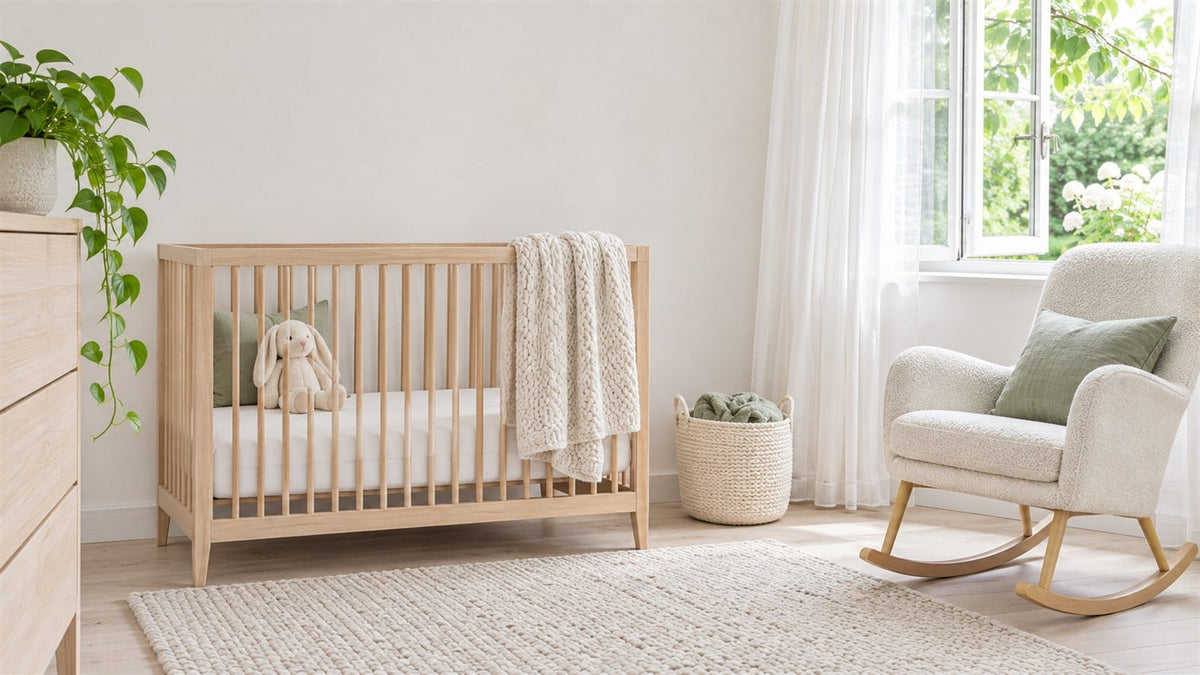
Quick answer: For healthy nursery air, start with the basics: air out the room regularly, keep humidity in a comfortable range (40–60%, with the EPA recommending 30–50%), and cut chemical sources such as air fresheners, harsh cleaners, and new furniture that is still releasing fumes. If you add an air purifier, choose a true HEPA model sized for the room that runs quietly and produces no ozone. Keep ionizers and ozone generators out of a baby's room. Follow your pediatrician's guidance and each product's age and use instructions.
A note before we start: This is general air-quality guidance, not medical advice. For anything about your baby's health, breathing, or specific conditions, talk to your pediatrician. Follow the age and use instructions on any product you bring into the nursery.
Why nursery air gets extra attention
Babies breathe faster than adults for their size, and in the first year they spend many hours in one room. That isn't a reason to worry. It's a reason to give that room some extra thought. The steps that matter most are free or inexpensive, and most of them don't involve buying anything.
Start with those basics. After that, this guide covers the question many parents ask: is an air purifier safe for a baby's room?
The free fundamentals (do these first)
Air out the room
Fresh air dilutes whatever builds up indoors, from cooking smells to the gases that new materials release. Open a window for a few minutes each day when the weather and outdoor air quality allow, and leave the nursery door open when you can so air moves through. If you live near a busy road or wildfire smoke is in the area, check the outdoor air quality index (AQI) first and keep the window closed on poor days.
Keep humidity in a comfortable range
Very dry air can leave skin and noses feeling dry, and damp air encourages dust mites and mold. A range of 40–60% is comfortable for most homes, and the EPA recommends 30–50% and below 60% to limit mold. In practice, aim for about 40–50% in a nursery.
- Measure it. A digital hygrometer costs about $10 to $15. Put it at crib height, away from the humidifier.
- In dry months, a cool-mist humidifier helps. Many pediatricians prefer cool-mist models because a warm-mist unit has hot water inside. Use distilled water if your tap water is hard, empty it daily, and clean it as the manual directs so it doesn't grow mold or bacteria.
- In damp climates or seasons, a dehumidifier in the room or nearby keeps humidity from creeping above 60%.
Our guide to improving indoor air quality naturally covers humidity for the rest of the home.
Cut the chemical load
Much of what affects nursery air is chemical, coming from products and new materials rather than dust:
- Skip plug-in air fresheners, scented candles, and aerosol sprays in the nursery. Fragrances add VOCs (volatile organic compounds) to the air rather than cleaning it.
- Use mild, fragrance-free cleaners for routine cleaning. Heavy disinfecting of every surface is rarely needed in a nursery, and our article on over-sanitizing explains when gentler routines make sense. Follow your pediatrician's advice on cleaning bottles, pacifiers, and feeding gear.
- Let new furniture, mattresses, and paint air out before the baby moves in. New materials release the most VOCs when they are new. Unwrap them and air them out in a ventilated space for as long as you can, ideally days to weeks. Choose low-VOC or zero-VOC paint, and paint well before the due date.
Keep surfaces and soft goods clean
Dust and dander collect in crib bedding, plush toys, rugs, and curtains. Wash crib sheets and washable soft toys in hot water regularly, vacuum floors and upholstery with a sealed HEPA vacuum, and keep clutter down so there are fewer places for dust to settle. A washable rug is easier to keep clean than wall-to-wall carpet.
Building a healthy home beyond the nursery? See how to improve indoor air quality naturally
Is an air purifier safe for a baby's room?
Generally yes, if you choose the right type. The type of device matters more than the brand.
A good choice: true HEPA purifiers. They filter airborne particles such as dust, pollen, and smoke and add nothing to the air. Look for:
- The right size. Check the CADR (clean air delivery rate), which measures how much filtered air the purifier delivers. A common rule of thumb is a smoke CADR of at least two-thirds of the room's floor area, so about 70 for a 100 sq ft nursery or about 100 for a 150 sq ft room. Choosing a unit with more capacity than you need lets it run on a lower, quieter speed.
- A low noise level. Look for the published noise level at the lowest speed. About 30 decibels is roughly the level of a whisper. Some parents like a steady hum as background noise, but it shouldn't be loud enough to make you raise your voice.
- A dimmable or switch-off display, so lights don't brighten the room at night.
- No ionizer, or one you can turn off. Check the manual for an "ion" or "plasma" button.
Avoid in a nursery: ionizers and ozone generators. Ozone irritates the lungs, and some ionizers release it as a byproduct while ozone generators make it on purpose. The EPA's guide to air cleaners in the home advises avoiding air cleaners that intentionally produce ozone. If a device doesn't clearly say it produces no ozone, leave it out of the nursery. In California, certified low-ozone devices carry an "ARB Certified" label.
Placement matters too. Put any device and its cord well out of reach, at least 3 feet from the crib, on a stable surface where it can't be pulled down. Don't put anything inside the crib. Keep the unit a little away from the wall so air can flow in and out.
A purifier adds to good habits but doesn't replace them. If the room smells musty, has visible mold, or feels stuffy, look for the source first.
Where surface treatment fits
Much of what builds up in a nursery sits on surfaces and in soft furnishings rather than floating in the air: dust, dander, and the organic residue left on bedding, rugs, and changing areas. A HEPA purifier cleans the air but does not reach that settled layer. Regular washing and vacuuming are the main tools for it.
Environmental probiotics are an optional extra layer for surfaces. A device releases beneficial Bacillus bacteria that settle on surfaces and consume the organic residue that odor-causing bacteria and mold feed on. These systems do not filter the air, so they would sit alongside a HEPA purifier rather than replace it.
For parents, the useful information is the safety facts:
- The probiotic formula is MADE SAFE certified.
- The formula is EPA registered as a bacteriostat and fungistat (EPA Reg. No. 94339-1). The registration covers the formula, not the device.
- The systems produce no ozone and no VOCs.
These are facts about the product's safety credentials, not promises about your baby's health. Follow the product's own age and use instructions, and check with your pediatrician if you have questions. You can read the full safety and certifications details before you decide.
If you're considering a unit for a nursery, the BioLogic Mini Gen 2 costs $98 and covers rooms up to 300 sq ft. Our BioLogic Mini Gen 2 review walks through it in detail.
A simple nursery-air checklist
- Before move-in: Air out new furniture, the crib mattress, and fresh paint in a ventilated space.
- Daily: Open a window briefly when the outdoor air is good, and empty and refill the humidifier if you use one.
- Ongoing: Keep humidity around 40–50%; no plug-ins, sprays, or scented candles in the nursery.
- Weekly: Wash crib sheets and soft toys in hot water; vacuum floors and upholstery with a sealed HEPA vacuum; clean the humidifier.
- If you add a device: Choose a true HEPA purifier sized for the room with no ozone output; keep it and its cord at least 3 feet from the crib; never use an ozone generator.
- Always: Follow your pediatrician's guidance and each product's age and use instructions.
The bottom line
Safe nursery air comes from the basics: fresh air, humidity in a comfortable range, few chemicals and fragrances, new furniture aired out before your baby arrives, and clean bedding and floors. If you add a device, a quiet true HEPA purifier sized for the room is the main option, and ionizers and ozone generators should stay out. A no-ozone probiotic system can treat surfaces as an extra layer if you choose. Your pediatrician is the final word on anything health-related.
Frequently asked questions
Is an air purifier safe for a baby's room? Generally yes, if you choose the right type. A true HEPA purifier filters particles and adds nothing to the air, so choose one sized for the room that runs quietly and produces no ozone. Avoid ionizers and ozone generators, keep the unit and cord at least 3 feet from the crib, and follow the product's instructions and your pediatrician's guidance.
What is the ideal humidity for a nursery? Most homes are comfortable at 40–60%, and the EPA recommends 30–50% and below 60% to limit mold, so about 40–50% works well for a nursery. Very dry air can dry out skin and noses, and damp air encourages dust mites and mold. Use a hygrometer to check, and clean any humidifier often.
How can I improve my baby's nursery air quality naturally? Air out the room when the outdoor air is good, keep humidity in range, and remove chemical sources such as air fresheners, scented candles, and harsh cleaners. Let new furniture and mattresses air out before the baby moves in. Wash crib bedding and soft toys in hot water and vacuum with a sealed HEPA vacuum.
Are ionizers safe for babies? Ionizers are best left out of a nursery. They charge particles so they settle onto surfaces rather than removing them, and some release ozone, a lung irritant. If you want a purifier, choose a true HEPA model that clearly states it produces no ozone.
Should I let new nursery furniture air out before my baby uses it? Yes. New furniture, mattresses, paint, and flooring release the most VOCs when they are new. Air them out in a well-ventilated space for as long as you can before the baby moves in, ideally days to weeks, and ventilate the nursery well afterward.
Do probiotic air systems make claims about babies' health? No. The relevant information is safety and certification: the formula is MADE SAFE certified and EPA registered as a bacteriostat and fungistat, and the systems produce no ozone or VOCs. These are safety facts about the product, so follow its age and use instructions and your pediatrician's advice.
Related reading
- BioLogic Mini Gen 2 review: a quiet probiotic purifier for the nursery
- How to improve indoor air quality naturally: the complete 2026 guide
- Are environmental probiotics safe? Safety data and certifications
- Stop over-sanitization: why harsh chemicals hurt your indoor microbiome
Considering a quiet, no-ozone unit for the nursery? Read our BioLogic Mini Gen 2 review

Leave a comment
This site is protected by hCaptcha and the hCaptcha Privacy Policy and Terms of Service apply.