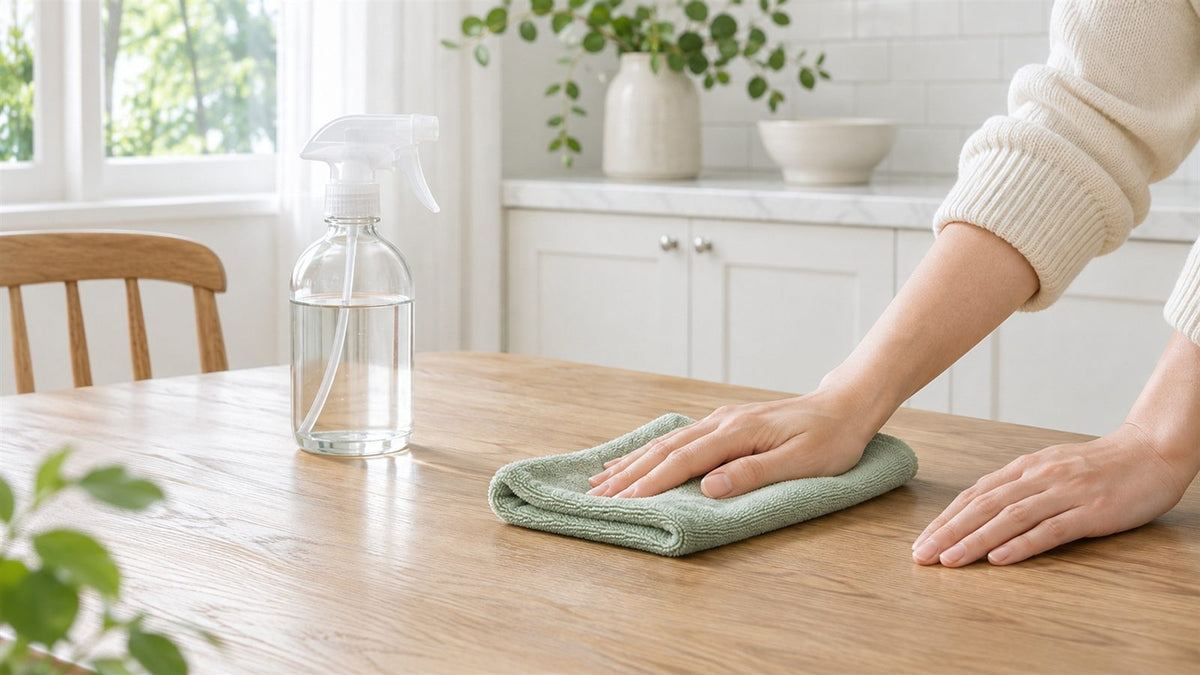
Quick answer: Probiotic cleaning products contain live beneficial bacteria, usually spore-forming Bacillus strains. After you apply them, the bacteria settle on the surface and break down the organic residue (grease, food film, skin flakes, dust) that odor-causing bacteria feed on. A chemical disinfectant acts for a few minutes and stops once it dries. A probiotic cleaner leaves live bacteria on the surface that keep consuming residue after you finish. Probiotic cleaners don't disinfect on contact, so keep a conventional sanitizer for raw-meat spills and illness.
Why surfaces get dirty again so fast
You wipe down the kitchen counter, the bathroom, or the corner where the dog sleeps, and it looks and smells clean. A day or two later the film and the smell are back. Conventional cleaning resets a surface at one moment, and the surface starts collecting residue and microbes again right away.
Chemical cleaners such as bleach, quaternary ammonium ("quat") sprays, and most disinfecting wipes kill microbes on contact. That is useful when you need a surface sanitized right now. The effect ends once the product dries, though. A freshly disinfected surface is open territory, and microbes from hands, air, pets, and food start moving back in within hours. Whichever ones grow fastest get there first, and those may not be the ones you would choose.
Probiotic cleaning takes a different approach. It leaves harmless bacteria on the surface so the space and food are already taken.
What "probiotic cleaning" means
A probiotic cleaner contains live beneficial bacteria. Most products use spore-forming Bacillus strains, the same broad group used in agriculture, wastewater treatment, and drain and septic treatments. Spores are a dormant, hardy form of the bacteria that survives in a bottle until it lands on a surface with moisture and food.
The process works in three stages:
- The bacteria settle. After you spray or wipe, the bacteria spread across the surface, including the small pores and scratches where residue collects.
- They break down residue. Bacillus bacteria produce enzymes that break down organic matter such as food film, grease, and skin flakes. That is the same residue odor-causing bacteria live on.
- They take up the space. With the space and food already in use, odor-causing microbes that land later have less to work with. Scientists call this competitive exclusion.
How long the effect lasts depends on the product, the surface, and what happens to it next. A counter you wipe with soapy water three times a day holds little of the probiotic layer, while a sofa or a carpet keeps it longer. The same idea applies to your home's microbiome, the natural community of microbes on your surfaces: a balanced, occupied surface tends to stay more stable than one wiped bare.
A note on allergens: dust mite and pet allergens are proteins, not living things, so they don't eat anything. What probiotic bacteria consume is the organic debris around them, such as the skin flakes dust mites feed on. Physical cleaning (hot washing and HEPA vacuuming) remains the main way to remove allergen itself.
Probiotic cleaner vs chemical cleaner
| Chemical cleaner (bleach, quats, disinfecting wipes) | Probiotic cleaner (Bacillus) | |
|---|---|---|
| How it works | Kills microbes on contact | Beneficial bacteria break down residue and compete with odor-causing microbes |
| How long it acts | Minutes, until it dries | Longer; varies with the product and how often the surface is cleaned |
| Effect on the surface | Leaves it empty, so microbes return quickly | Leaves it occupied by harmless bacteria |
| Odor | Removes or masks odor briefly | Works on the residue odor-causing bacteria feed on |
| Resistance | Heavy routine use is a concern | No known resistance pressure |
| Fumes and residue | Some products irritate eyes and lungs; residue left behind | Typically low-fume; check the label for fragrance |
| Best for | Raw-meat spills, illness, bodily fluids | Everyday upkeep and odor-prone areas |
The two kinds of cleaner are different tools. A fast chemical sanitizer still has a place: after you prepare raw chicken, when someone in the house has a stomach bug, or for any mess involving bodily fluids. Probiotic cleaning suits routine upkeep, the weekly maintenance that keeps a home smelling fresh between deep cleans.
Curious how the mechanism works? Read about competitive exclusion
What probiotic cleaning does and doesn't do
Setting expectations up front keeps you from buying the wrong product for the job.
Probiotic cleaning works well for:
- Lingering odors in trash cans, pet areas, laundry rooms, and soft furnishings. Odor often comes from bacteria feeding on residue, and probiotic bacteria work on that residue. Our guide to how to get rid of musty smells goes deeper.
- Organic buildup on surfaces, the film that feeds odor-causing bacteria and mold.
- Low-fume upkeep for homes that want fewer harsh chemicals, including homes with children and pets.
Probiotic cleaning is not:
- An on-contact disinfectant. It works over hours, not seconds.
- A replacement for sanitizing after high-risk messes such as raw meat juices, bodily fluids, or chemical spills. Use a conventional sanitizer for those, rinse, and apply the probiotic product once the surface is dry.
- A product you can see working. You won't see it foam or fizz. The result is a home that stays fresh longer between cleanings.
If a probiotic product promises to sanitize as fast as bleach, be skeptical. The biology doesn't work that way.
Why it matters: you may be over-cleaning
Disinfecting every surface every day has costs. It removes harmless microbes along with harmful ones, it can leave chemical residue and fumes in the air, and heavy routine use of antimicrobial products is a concern for resistance. We cover this in our article on over-sanitizing your home.
Probiotic cleaning offers a practical middle path. You keep disinfectants for the jobs that need them and use soap, water, and a probiotic layer for everything else. That means fewer harsh chemicals and a surface that stays fresh longer.
How to choose a probiotic cleaner
Probiotic cleaners vary a lot. Check these points on the label before you buy:
- Live cultures listed. Look for named strains or a stated bacteria count (often listed as CFU, colony-forming units). "Probiotic-inspired" or "enzyme" alone may mean there are no live bacteria.
- Spore-forming bacteria. Bacillus spores survive storage far better than non-spore-forming bacteria, so the product stays active on the shelf.
- No added disinfectant. A cleaner that combines live bacteria with a strong disinfectant works against itself. Check the ingredient list.
- Fragrance. If anyone in your home is sensitive to scents, choose a fragrance-free product.
- Shelf life and storage. Check the expiration date and storage instructions, since the cultures lose strength over time and in heat.
- Claims and registration. A cleaner that claims to kill or control microbes must be registered with the EPA. A product that claims only to clean or remove odor doesn't need registration. Read the claims carefully, and look for an EPA registration number if a product says it controls bacteria or mold.
A simple probiotic cleaning routine
You don't need to change how you clean from scratch. A practical routine:
- Clean first. Remove visible dirt, dust, and spills with your usual method. Probiotic products work best on a surface that is already tidy.
- Apply the probiotic product. Spray or wipe it on and let it air-dry. For soft surfaces such as sofas, pet beds, and carpet, mist lightly rather than soaking.
- Skip the bleach afterward. Don't spray disinfectant on the same surface right after, since it kills the bacteria you applied. Save disinfectant for the high-risk messes listed above.
- Repeat on a schedule. Reapply in odor-prone spots weekly, or as the label directs.
A spray bottle treats one surface at a time. For a whole room, an environmental probiotic device automates the second step. The BioLogic Mini Gen 2 ($98, up to 300 sq ft) releases a fine mist of beneficial Bacillus bacteria on a schedule, so it settles on every surface in the room, including the corners and fabrics you don't clean every week. Its formula is MADE SAFE certified and EPA registered as a bacteriostat and fungistat; the registration covers the formula, not the device.
The bottom line
Probiotic cleaning products replace the "disinfect everything, then repeat tomorrow" cycle with a different model: leave harmless beneficial bacteria on the surface to break down residue and compete with odor-causing microbes. They don't disinfect on contact and they aren't for high-risk messes. For everyday upkeep, they keep working on the surface after you put the bottle away.
Frequently asked questions
What are probiotic cleaning products? Probiotic cleaning products are cleaners that contain live beneficial bacteria, usually Bacillus strains, instead of or alongside chemical ingredients. The bacteria settle on the surface and break down the organic residue that odor-causing bacteria and mold feed on. Unlike a disinfectant, they leave live bacteria on the surface after you finish cleaning.
Do probiotic cleaners work? Yes, for what they are designed to do: everyday surface upkeep and odor reduction. The beneficial bacteria break down residue and compete with odor-causing microbes for food and space. They are not on-contact disinfectants, so use a conventional sanitizer for raw-food spills and illness, then apply the probiotic product afterward.
Are probiotic surface cleaners safe for kids and pets? It depends on the product, so read the label for fragrance, added chemicals, and any certifications. For EnviroBiotics devices, the probiotic formula is MADE SAFE certified and EPA registered as a bacteriostat and fungistat; the registration covers the formula, not the device. Our devices produce no ozone, VOCs, or chemical residue and are safe for continuous use around infants, children, pregnant adults, older adults, and pets.
Can I use a probiotic cleaner and a regular cleaner together? Yes, one after the other. Clean visible dirt and any high-risk mess with your usual method first, then apply the probiotic product. Avoid spraying bleach or disinfectant on the same surface right afterward, since it kills the bacteria you applied.
What's the difference between a probiotic cleaner and a probiotic air purifier? A probiotic cleaner is a spray or wipe you apply by hand to specific surfaces. A probiotic air purifier, such as the BioLogic Mini Gen 2, is a device that releases a fine mist of beneficial Bacillus bacteria on a schedule, so it settles across every surface in a room. The device automates the same kind of surface treatment for the whole space.
Do probiotic cleaners help with odors? Yes, and odor is one of their best uses. Many lingering household odors come from bacteria feeding on organic residue on surfaces. Probiotic cleaners break down that residue and compete with the odor-causing bacteria, so the smell has less to come back from than it does after a fragrance spray wears off.
Related reading
- Competitive exclusion explained: how beneficial bacteria compete on surfaces
- What is indoor microbiome health?
- Stop over-sanitization: why harsh chemicals hurt your indoor microbiome
- How to get rid of musty smell in your house: the probiotic approach
Ready to add ongoing probiotic surface treatment to a room? Meet the BioLogic Mini Gen 2.

Leave a comment
This site is protected by hCaptcha and the hCaptcha Privacy Policy and Terms of Service apply.