
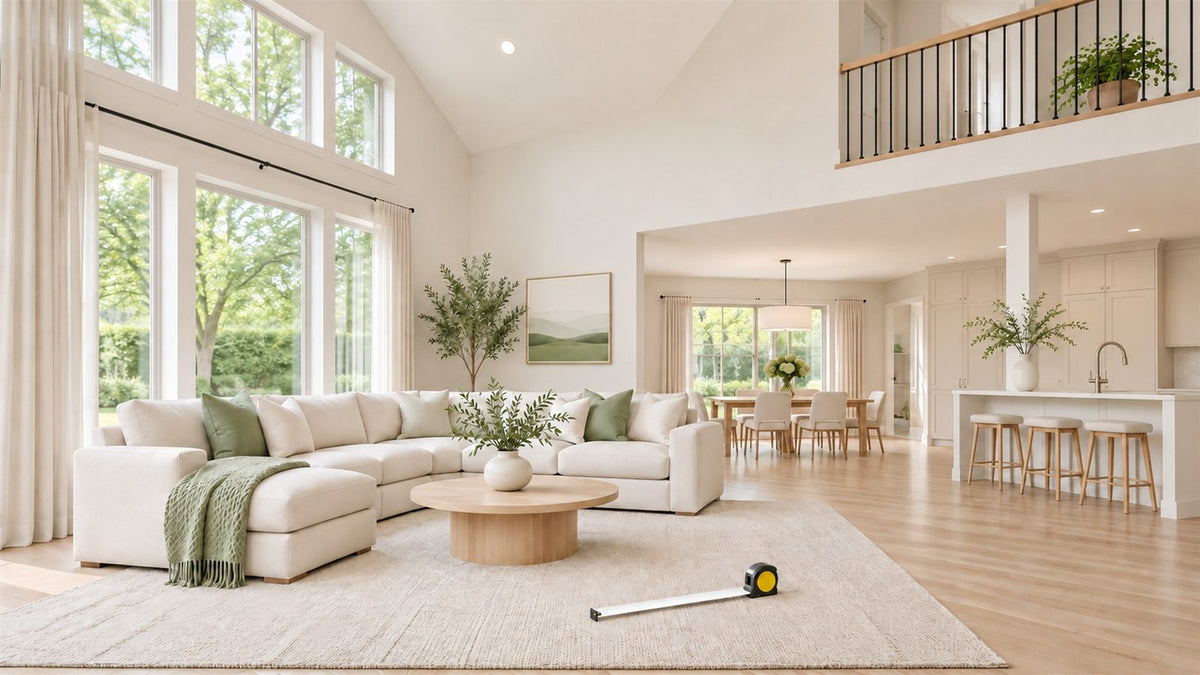
Quick answer: Size an air purifier by its CADR (clean air delivery rate, in cubic feet per minute), not by the square footage on the box. The standard rule is that the smoke CADR should be at least two-thirds of the room's floor area in square feet. A 300 sq ft room needs a smoke CADR of about 200. With an 8-foot ceiling, that works out to roughly 5 air changes per hour, which suits allergies and everyday use. For wildfire smoke or extra headroom, choose a smoke CADR equal to the room's square footage.
The three numbers, and which one to trust
Air purifiers are described with some mix of three figures. They aren't equally useful.
CADR (clean air delivery rate). How much filtered air the unit delivers, in cubic feet per minute (cfm). CADR comes from a standard test administered by AHAM, the Association of Home Appliance Manufacturers, and is published as three numbers: smoke, dust, and pollen (AHAM). Smoke particles are the smallest and hardest to capture, so the smoke CADR is usually the lowest of the three and the best one to size by. CADR is measured with a new filter at the unit's highest speed (EPA).
ACH (air changes per hour). How many times per hour the purifier can filter a volume of air equal to your whole room. CADR is the machine's spec; ACH is what that spec delivers in your room. Ceiling height matters here, because a taller room holds more air.
"Covers up to X square feet." The figure most people buy on. On units in AHAM's program, the suggested room size follows the two-thirds rule, so it lines up with the smoke CADR. Some product pages also print a much larger area based on fewer air changes, such as the area a unit can filter once an hour. Read the fine print to see which figure you're looking at, and assume it means an 8-foot ceiling, a closed room, a new filter, and the highest fan speed.
A coverage claim is a reasonable starting point. CADR lets you check it against your actual room and your goal.
How many air changes do you need?
There is no official ACH requirement for homes. The targets below are widely used conventions, not standards, and the higher ones line up with AHAM's sizing advice.
| Situation | Target ACH | Where it comes from |
|---|---|---|
| General freshening, no specific concern | About 2 | Common convention |
| Allergies, pets, everyday use | About 4–5 | Convention; matches the two-thirds rule (about 4.8 to 5 ACH at an 8 ft ceiling) |
| Wildfire smoke, heavy pollution, or extra headroom | About 7.5 | AHAM recommends a smoke CADR equal to room area for wildfire smoke, which is about 7.5 ACH at 8 ft |
The two-thirds rule comes from AHAM: "the CADR of your air cleaner should be equal to at least two-thirds of the room's area" (AHAM). The EPA's sizing chart uses nearly the same ratio, for example 195 cfm for a 300 sq ft room (EPA).
A unit that seemed to "do nothing" was often sized for fewer air changes than the household needed, or ran on a low setting most of the time. It probably removed particles, but not much faster than new ones came in. Choosing a purifier for a specific allergen is a separate question, covered in our guide to the best air purifier for allergies. Here we cover capacity only.
The calculation
Four steps, worked through for a real room.
Step 1: Find your room's volume. Multiply length × width × ceiling height, in feet.
A 20 ft × 15 ft living room with a 9 ft ceiling = 2,700 cubic feet.
Step 2: Multiply by your target ACH. That gives the cubic feet of air you need filtered per hour.
2,700 × 5 air changes = 13,500 cubic feet per hour.
Step 3: Divide by 60 to convert to cubic feet per minute, the unit CADR uses.
13,500 ÷ 60 = 225 cfm.
Step 4: Buy a unit with a smoke CADR at or above that number.
Look for a smoke CADR of 225 or higher.
The shortcut, for an 8-foot ceiling, is the two-thirds rule: required smoke CADR ≈ room area in sq ft × 2/3. It is the same arithmetic as above at about 5 air changes per hour. For wildfire smoke, use CADR ≈ room area instead.
Required CADR by room size
Assumes an 8-foot ceiling. For a 9-foot ceiling, add about 12%; for a 10-foot ceiling, add about 25%.
| Room size | Volume (8 ft ceiling) | CADR for 2 ACH | CADR for 4 ACH | CADR for about 5 ACH (two-thirds rule) | CADR for 7.5 ACH (smoke; CADR = area) |
|---|---|---|---|---|---|
| 100 sq ft (small bedroom) | 800 cu ft | 27 | 53 | 67 | 100 |
| 150 sq ft (bedroom) | 1,200 cu ft | 40 | 80 | 100 | 150 |
| 200 sq ft (large bedroom) | 1,600 cu ft | 53 | 107 | 133 | 200 |
| 300 sq ft (living room) | 2,400 cu ft | 80 | 160 | 200 | 300 |
| 400 sq ft (large living room) | 3,200 cu ft | 107 | 213 | 267 | 400 |
| 500 sq ft (open-plan area) | 4,000 cu ft | 133 | 267 | 333 | 500 |
| 800 sq ft (large open plan) | 6,400 cu ft | 213 | 427 | 533 | 800 |
Two patterns stand out. Moving from light use to the two-thirds rule more than doubles the capacity you need, and smoke-level sizing nearly quadruples it. Above about 500 sq ft, a single portable unit gets large and loud, which is when two units, or a whole-house approach, becomes worth comparing.
Not sure what you're trying to remove?
Buy bigger, run it slower
This may be the most useful buying advice in this guide, and few people follow it.
Makers publish CADR at the highest fan speed. The highest speed is also the loudest, often loud enough that people turn it down at night or switch it off. A purifier that is switched off delivers no clean air, so noise affects performance as much as comfort. The EPA notes that an air cleaner filters less air at a lower speed, and that noise depends on the fan setting.
The fix is to size up on purpose. Choose a unit whose smoke CADR comfortably exceeds your target, so that on low or medium it still delivers the air changes you want at a noise level you can sleep through. Check the maker's spec sheet for CADR or noise at each speed if it is listed. The bigger unit costs more upfront and is easier to live with, and if it runs on low or medium instead of high, it often uses less power than a smaller unit running flat out. Since filters and electricity make up most of the long-run cost to run, that trade usually pays off.
Where the arithmetic breaks down
The formula assumes a closed box with evenly mixed air. Real homes are messier.
- Open-plan spaces. Air doesn't stop where you'd draw the room boundary. Calculate the full connected volume, including a hallway or kitchen with no door.
- Closed doors. A purifier does very little for the room next door. Each closed room needs its own unit, which is why room-by-room purifiers add up quickly. We compare that with whole-home options in room unit vs whole-home.
- High or vaulted ceilings. Use the real volume, not the floor area alone. A vaulted room can hold 50% more air than its square footage suggests, and both AHAM and the EPA say to size up for ceilings above 8 feet.
- Placement. A unit pushed against a wall or tucked behind furniture can't pull in air freely, and it delivers less than its rating. Leave clearance on all sides, as the manual directs.
- Filter loading. CADR is measured with a new filter, and delivery drops as the filter fills. A unit sized with no margin will fall short within months.
- Drafty rooms. Outdoor air leaking in around windows and doors keeps bringing back what the purifier removed.
Real-world delivery usually falls short of the rated figure for all of these reasons together. That's expected, and it is why sizing with headroom is the standard advice.
What CADR doesn't tell you
CADR is a good metric for one thing: how fast a unit removes airborne particles. Several things people buy purifiers for fall outside it.
Gases and VOCs. CADR measures particles. Formaldehyde from new furniture, cooking fumes, and solvent smells are gases, and removing them takes a substantial activated carbon stage. The thin carbon-dusted sheet in many budget units does very little. No CADR figure tells you about this, so check the weight of carbon the maker lists.
Anything that has already settled. This is the largest gap and the least understood. A purifier can only treat air that passes through it. Much of what people want gone, such as dust mite allergen in a mattress, pet dander worked into a sofa, or mold on a damp windowsill, sits on and inside furnishings rather than circulating. Air doesn't flow through a cushion, so doubling your CADR won't touch it. We compare the two in probiotic vs HEPA.
That is where our own products fit. EnviroBiotics systems have no CADR rating, because CADR measures airborne particle removal, and that isn't what they do. They release beneficial Bacillus bacteria that settle on surfaces and consume the organic residue that odor-causing bacteria and mold feed on. So they are sized by floor area rather than airflow: the Biotica 800 ($299) treats rooms up to 800 sq ft and works alongside a filter, not in place of one. If your problem is pollen or smoke in the air, size a HEPA purifier with the table above. That is the right purchase, and no probiotic system substitutes for it.
Common sizing mistakes
- Buying on the coverage claim alone. Check which figure it is, then confirm with the smoke CADR.
- Comparing one unit's pollen CADR with another's smoke CADR. Compare like with like; smoke is the strictest.
- Sizing exactly to target with no headroom, then losing capacity as the filter fills.
- Buying one unit for a house with closed doors. It only treats the room it's in.
- Forgetting about noise until it's in the bedroom, then running it on low and getting far less than the rated CADR.
- Assuming an 8-foot ceiling in a room that has a higher one.
- Expecting a particle filter to fix a gas, moisture, or surface problem it was never designed for.
The bottom line
Multiply your room's length, width, and ceiling height. Multiply by about 5 for everyday and allergy use (the two-thirds rule), or about 7.5 for wildfire smoke, and divide by 60. That is the smoke CADR to shop for, and it is often higher than the box suggests. Then buy a size up so you can run it on low or medium, because a quiet purifier is one you'll leave on.
If you size it correctly, run it consistently, and dust, odor, or stuffiness still persists, the cause may not be airborne particles. Check for gases, excess moisture, and surfaces that need cleaning, and if anyone has ongoing symptoms, see a doctor.
Frequently asked questions
What size air purifier do I need for my room? Use the two-thirds rule: the smoke CADR should be at least two-thirds of the room's floor area in square feet, assuming an 8-foot ceiling. A 300 sq ft room needs a smoke CADR of about 200, which delivers roughly 5 air changes per hour and suits allergies and everyday use. For wildfire smoke or extra headroom, choose a smoke CADR equal to the room's square footage.
What is CADR and why does it matter? CADR stands for clean air delivery rate. It is measured in cubic feet per minute in a standard test administered by AHAM, and it is published separately for smoke, dust, and pollen. It matters because it is a tested performance figure you can use to size a unit for your room. Use the smoke CADR, since smoke particles are the hardest to capture.
How many air changes per hour do I need? There is no official home standard, so these are common conventions. About 2 air changes per hour suits general freshening, about 4 to 5 suits allergies, pets, and everyday use (the two-thirds rule gives roughly 5 at an 8-foot ceiling), and about 7.5 suits wildfire smoke. Higher ceilings mean you need more CADR for the same number of air changes.
Is it better to buy a bigger air purifier than I need? Usually, yes. CADR is rated at the highest fan speed, which is also the loudest, so a larger unit running on low or medium can reach your target more quietly. A purifier quiet enough to leave on does more than a correctly sized one that gets switched off at night. A bigger unit also leaves headroom as the filter fills.
Do I need an air purifier in every room? For separate rooms with closed doors, usually yes, because air doesn't mix well between them and a purifier only treats the space it's in. Open-plan areas can be treated as one volume, so measure the full connected space, including hallways without doors. Once you need several units, compare the total cost with a whole-house option.
How do I calculate air changes per hour? Multiply your room's length, width, and ceiling height to get its volume in cubic feet. Multiply the volume by your target air changes per hour, then divide by 60 to get the cubic feet per minute you need, which you can compare directly with a unit's CADR. For example, a 2,700 cubic foot room at 5 air changes per hour needs 13,500 cubic feet per hour, or 225 cfm.
Does CADR tell you everything about an air purifier? No. CADR measures only how fast a unit removes airborne particles. It says nothing about gases and VOCs, which need a substantial activated carbon stage, or about dust and allergens already settled in carpets, mattresses, and upholstery, which airflow can't reach. It is also measured with a new filter at top speed, so real-world performance is lower.
Related reading
- Best air purifier for allergies in 2026: probiotic vs HEPA vs ionizers
- How to test your indoor air quality at home (and what every test misses)
- What does an air purifier really cost to run? Filters, refills and energy
- Probiotic vs HEPA air purifier: which actually protects your home?
Sized correctly and still fighting dust or odor? The problem may not be airborne

Leave a comment
This site is protected by hCaptcha and the hCaptcha Privacy Policy and Terms of Service apply.