
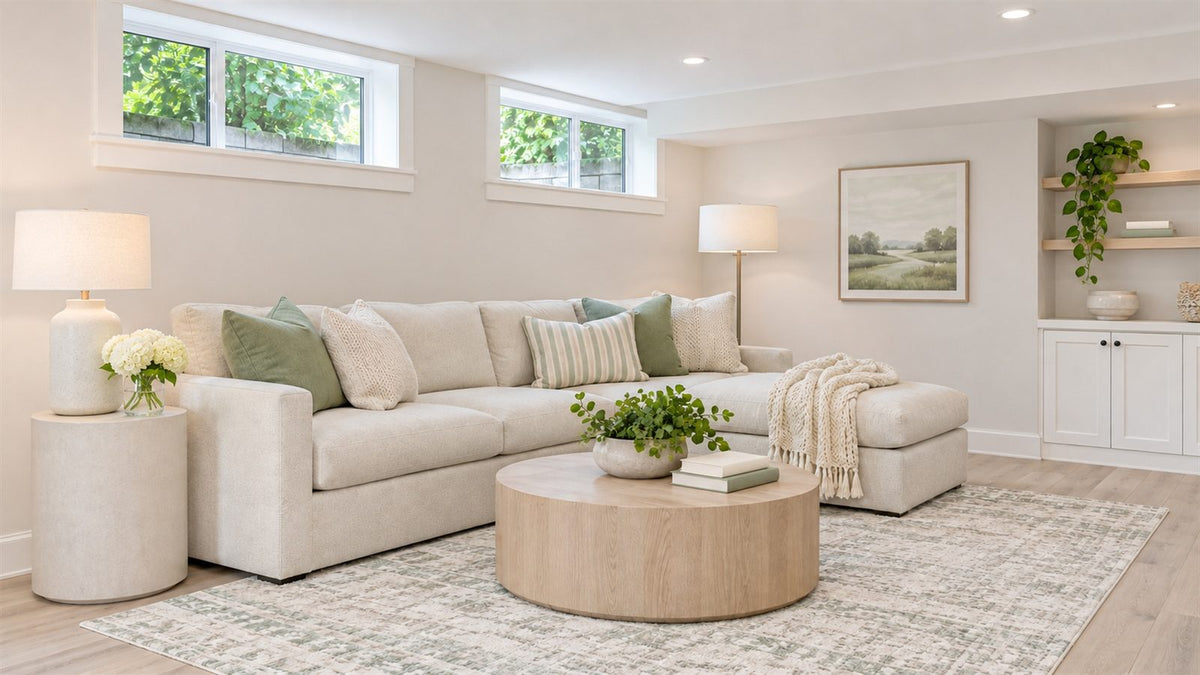
Quick answer: For most basements, an air purifier should not be the first purchase. If the space is damp, start with a dehumidifier connected to a drain and fix any water coming in. Then add a true HEPA purifier with enough clean air delivery rate (CADR) for the room, plus a carbon filter if the basement smells musty or you store paint and solvents there. Radon needs a test and, if levels are high, a mitigation system. No HEPA, carbon, or probiotic unit removes radon gas. A probiotic unit is an optional final step once the basement is dry.
Basement problems come in layers
A basement is colder than the rest of the house, often damper, often full of cardboard boxes and half-used cans of paint, and it sits directly on soil that can release radon. Each of those needs its own fix.
| Layer | Tool | What happens if you skip it |
|---|---|---|
| Water getting in | Gutters, grading, sealing leaks, draining condensate | Every machine fights a losing battle |
| Humidity | A dehumidifier sized for the space, draining to a floor drain or pump | Mold keeps growing and releasing spores |
| Airborne spores and dust | A true HEPA purifier with a published CADR | Walking across the rug stirs everything up again |
| Odors and fumes from storage | A purifier with a substantial carbon filter, plus fewer stored chemicals | The air looks clean but still smells like a workshop |
| Radon | A test kit, then mitigation if the level is high | Filters do not lower radon gas |
| Lingering residue on surfaces | Cleaning, then optionally a Biotica 800 | Only after every layer above is handled |
For a closer look at which appliance to buy first, read air purifier vs dehumidifier for mold. For a broader list of purifier features for mold-prone homes, see best air purifier for mold. This article focuses on the basement itself.
Step one: water and humidity
Put a hygrometer in the middle of the basement, away from the dehumidifier's exhaust. Across the house we use 40–60% as a comfortable range, and the EPA recommends keeping indoor humidity between 30 and 50% and below 60%. Basements are the place to aim for the lower half. If readings sit above 50 to 60% for days at a time, mold has the moisture it needs.
Choose a dehumidifier that can drain continuously to a floor drain or condensate pump. A bucket that fills up while you are away stops the machine, and humidity climbs again. Set it to about 45 to 50% and check the hygrometer for the first few weeks.
Our guide on how to prevent mold naturally covers moisture control and cleanup with mild products. If you see a large area of mold, or growth keeps coming back in the same spot, call a professional.
Running a purifier in a basement at 65% humidity will capture some spores, but the mold keeps producing more. Dry the space first.
What to look for in a basement air purifier
Once humidity is under control, look for:
- True HEPA, not "HEPA-type" or "HEPA-like."
- Enough CADR for the room. Use the CADR figures, not the square footage printed on the box. See the sizing section below.
- A housing you can wipe clean. Basements can be damp. A hard plastic or metal case is easier to keep clean than a fabric-covered intake.
- A carbon filter if the basement smells musty or like a workshop. Carbon handles odors in the air. If the musty smell comes from an old sofa or carpet stored downstairs, our guide to musty smell covers what to do about the source.
Large models from established brands such as Coway, Blueair, and Levoit are the kind of machine to consider. Compare their current published CADR, how loud they are on the setting you will leave running, and the cost of replacement filters. We do not sell HEPA purifiers.
How you use the space affects how you run it. In an unfinished basement used mostly for storage, the dehumidifier should run all season, and the purifier can run when you are down there. A finished basement used as a family room should be treated like any other living space: run the purifier all day on auto or low.
Sizing a purifier for a basement
A common rule from the appliance industry is to choose a purifier whose smoke CADR (in cubic feet per minute) is at least two-thirds of the room's floor area in square feet. In a room with 8-foot ceilings, that works out to about five air changes per hour, which is a convention used for allergen control. Many basements have ceilings closer to 7 feet, so the same CADR gives you a few more air changes. If you want extra headroom, for heavy dust or smoke, choose a smoke CADR close to the full floor area.
| Basement size | Minimum smoke CADR (two-thirds rule) | For extra headroom |
|---|---|---|
| 300 sq ft | 200 cfm | 300 cfm |
| 500 sq ft | about 330 cfm | 500 cfm |
| 800 sq ft | about 530 cfm | 800 cfm |
| 1,000 sq ft | about 670 cfm | 1,000 cfm (usually two units) |
Our guide to what size air purifier you need explains CADR and air changes in more detail.
A compact bedroom purifier, such as the Levoit Core 300, is designed for a bedroom-sized space. In a large finished basement, it will deliver far fewer air changes. Check each maker's listed CADR against the table above.
If your basement is L-shaped or divided into rooms, one purifier will not clean air around the corner well. Two smaller units, one in each area, usually work better than one large unit tucked into an alcove. The dehumidifier is different: put it in the dampest area, which is often not where you sit.
Radon: test, don't filter
Radon is a radioactive gas that seeps up from the soil and is often highest in basements. It has no smell and causes no symptoms you would notice, but long-term exposure raises the risk of lung cancer. HEPA filters catch particles, not gases. A filter may capture some of the particles that radon's decay products attach to, but it does not lower radon levels and is not a substitute for mitigation.
Test the lowest level of your home that you use or plan to use as living space. Our guide on how to test indoor air quality covers radon kits and monitors. The EPA advises fixing your home if radon is at or above 4 picocuries per liter (pCi/L) and considering a fix between 2 and 4 pCi/L. Mitigation usually means a sub-slab depressurization system installed by a certified radon professional. Do not buy an air purifier as a radon plan.
Where a probiotic unit fits
If your basement is a dry, lived-in room and still has a lingering stale or musty smell after you have dried and cleaned it, a Biotica 800 ($299, rooms up to 800 sq ft) is the room-sized surface option. It releases beneficial bacteria that settle on furniture, carpet, and other surfaces, where they consume the organic residue that odor-causing bacteria and mold feed on.
If the basement has standing water, is a crawl space, or is packed with damp storage boxes, spend your money on a sump pump, a dehumidifier, and clearing out what you don't need.
The probiotic formula is EPA registered as a bacteriostat and fungistat (EPA Reg. No. 94339-1). The registration covers the formula, not the device. The unit does not lower humidity, does not remove mold that is already growing, and does nothing for radon.
Finished, unfinished, or home gym
Unfinished storage space. Run a dehumidifier, move cardboard boxes off the slab onto shelves or into plastic bins, and use a HEPA purifier when you spend time sorting things down there.
Finished family room. Treat it like a living room with a lower ceiling. Run a HEPA purifier all day, add carbon if workshop smells drift in, and consider surface treatment if older furniture has moved downstairs.
Home gym. Rubber flooring, chalk, and sweat add dust and odor. A HEPA purifier helps with dust. Ventilate when you can, and wipe down equipment and mats after use.
Guest suite or rental unit. Test for radon before anyone sleeps there, and fix it if the level is high.
Paint cans, solvents, and storage
Fumes from stored paint, solvents, gasoline, and pesticides will quickly saturate a thin carbon filter. The better fix is to remove them. Take what you no longer need to your local household hazardous waste collection. Store what you keep in sealed containers, away from any play or living area, and ideally in a detached shed or garage.
Carpet on a concrete slab
Wall-to-wall carpet over a slab that sometimes gets damp can trap moisture and grow mold underneath. A HEPA purifier catches what gets kicked up, but the lasting fix is controlling humidity, and sometimes replacing the carpet and pad with a moisture-tolerant floor. Air fresheners only cover the smell.
If you finish the basement later, size your equipment again. A new bathroom, carpet, and furniture change the moisture load and the CADR the room needs, and a dehumidifier bought for an empty slab may become too small.
When to call a professional
Call a contractor or specialist if water keeps returning after you dry the space, mold grows back on the same patch, radon tests at or above 4 pCi/L, sewage backs up, or you smell exhaust near the furnace or water heater. An exhaust smell can mean a fuel-burning appliance is not venting properly, so make sure you have working CO alarms and call an HVAC technician. None of these are problems an air purifier can solve.
The bottom line
Dry the basement first. Then filter the air with a properly sized true HEPA purifier, add carbon if odors or stored chemicals are an issue, and test for radon. Treat surfaces last, once the space is dry and clean.
Frequently asked questions
What is the best air purifier for a basement? A true HEPA purifier with enough CADR for the floor area, plus a carbon filter if odors or stored chemicals are a concern. Buy it after humidity is under control. Choose a model based on its current published CADR, noise, and filter costs.
Do I need a dehumidifier or an air purifier in the basement? If the basement is damp, get the dehumidifier first. Many finished basements need both: a dehumidifier to control humidity and a HEPA purifier for spores and dust in the air.
Will an air purifier remove radon? No. Radon is a gas, and HEPA filters capture particles. Test your home, and if radon is at or above 4 pCi/L, have a certified professional install a mitigation system.
Can I use a probiotic air purifier in the basement? Yes, as a surface treatment once the space is dry and clean. It does not remove mold that is already growing, lower humidity, or replace a dehumidifier. If you see active mold, address the moisture and clean or remove the growth first.
Should I run the basement purifier 24/7? If people spend hours in the basement, yes, on auto or a low setting. If it is mainly storage, run the purifier while you are down there and keep the dehumidifier running through the damp season.
Can I use the same purifier I use upstairs? Yes, if its CADR is large enough for the basement. A bedroom-sized unit is usually too small for a large finished basement. Only move it if you will keep it running down there.
Do I need carbon if the basement smells like concrete? Maybe not. Dry the space first, because a damp, mineral smell often fades once humidity drops. Add carbon if a chemical or musty smell remains after the basement is dry.
Related reading
- Air purifier vs dehumidifier for mold
- Best air purifier for mold
- How to test indoor air quality at home
- How to get rid of musty smell
If the finished basement is dry and still biologically 'off'


Leave a comment
This site is protected by hCaptcha and the hCaptcha Privacy Policy and Terms of Service apply.