
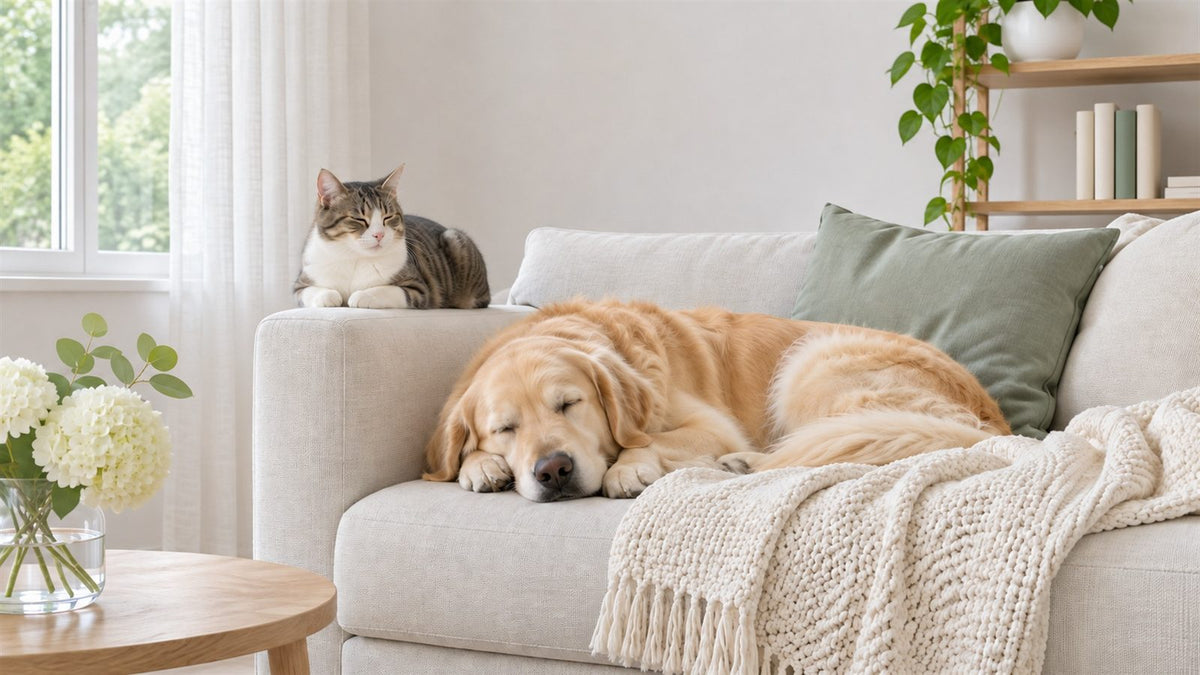
Quick answer: For most pet homes, the best air purifier is a true HEPA purifier with a washable pre-filter and a substantial carbon filter, sized to the room by its CADR (clean air delivery rate). It captures airborne dander and some odor. Dander and odor also build up in the sofa, the rug, and the pet bed, where no filter reaches. For those surfaces, a probiotic surface treatment works alongside the HEPA purifier rather than replacing it. Choose equipment by the job you need done, not by the picture of a dog on the box.
Hair, dander, and smell are three separate problems
Many pet owners buy one machine and expect it to handle three unrelated things.
Hair is large and heavy. It clogs purifier intakes and collects in carpets. The right tools are a washable pre-filter, a vacuum built for pet hair, and regular brushing. If a purifier markets itself mainly on hair, most of what you are paying for is the pre-filter.
Dander is tiny flakes of skin, along with the allergen proteins attached to them. Some of it floats, and HEPA captures that share. Much of it settles into fabrics, which is why cleaning the air alone doesn't clear a home with a cat. Cat allergen can stay airborne for hours before it settles, so a cat home needs both filtration and surface cleaning. Our step-by-step guide on how to reduce pet dander without chemicals covers the cleaning routine.
Odor: much pet odor comes from bacteria breaking down skin oils, saliva, and accidents on those same fabrics. Carbon absorbs some of the smell that is already in the air, but it can't pull urine out of carpet padding. For removing the source, see our guide on how to get rid of pet odor.
Products that promise to handle all three in one box are a common reason people return purifiers.
What a HEPA purifier does in a pet home
A true HEPA purifier captures airborne dander, some mold spores, and the dust that flies when a dog shakes off. That is a meaningful benefit, and it is why our guide to the best air purifier for allergies still starts with a filter when pollen or airborne dander is the concern.
Shop by these specifications rather than by the word "pet" in the model name:
| Spec | Why it matters in a pet home |
|---|---|
| Smoke CADR | Use the common two-thirds rule: the smoke CADR should be at least two-thirds of the room's area in sq ft (for 8-foot ceilings). Ignore the coverage claim on the box |
| Washable pre-filter | This is where hair collects. If you can't wash it, you'll replace filters far more often |
| Granular or pelleted carbon | Handles everyday pet smell in the air; a thin carbon-dusted sheet fills up quickly |
| AHAM Verified CADR | AHAM (the Association of Home Appliance Manufacturers) independently verifies CADR, so you can compare models fairly |
| Low-speed noise | A purifier too loud for night gets switched off, often when the pet is on the bed |
Coway Airmega, Winix, Levoit's Core and Vital series, Blueair, and Dyson models with sealed HEPA can all be the right air purifier if the CADR fits your room. Models change every year, so use the specifications above to compare whatever is on the shelf. If you already own a good HEPA purifier, keep it.
A HEPA purifier can't clean a couch cushion, because no air flows through upholstery.
Where a probiotic system helps
Once dander and skin oils work into fabrics, the goal is to keep that organic film from feeding odor-causing bacteria and from releasing dust and dander every time someone sits down.
A room unit such as the Biotica 800 ($299, covers up to 800 sq ft) releases beneficial Bacillus bacteria that settle on those surfaces. They consume the organic residue that odor-causing bacteria feed on, between your vacuuming and laundry days. If your pet sleeps in a bedroom of 300 sq ft or less, the BioLogic Mini Gen 2 ($98) is the smaller option.
Pet owners will want the safety facts. The probiotic formula is EPA registered as a bacteriostat and fungistat; the registration covers the formula, not the device. The formula is MADE SAFE certified. The system adds no ozone, VOCs, or chemical residue and is safe for continuous use around infants, children, pregnant adults, older adults, and pets. Our pet safety data article has the details.
A probiotic system won't replace blotting up a fresh accident, and it won't pick hair off a baseboard.
The dander protocol, step by step
Cats, dogs, and birds: what changes
Dogs. Dogs shed more hair and more skin oil, and much "dog smell" comes from bacteria on fabrics. Focus on a washable pre-filter, granular carbon, and a good vacuum. If you add surface treatment, put it in the room where your dog spends most of its time, which is usually the living room.
Cats. Cats shed less hair, but cat dander is a common allergen, and urine can soak through to carpet padding. Use HEPA for airborne dander. Avoid ozone generators and essential-oil "pet purifiers," since many essential oils are toxic to cats. Clean accidents with an enzyme cleaner before you rely on any ongoing treatment.
Birds. Feather dust is fine and stays airborne, so a HEPA purifier with enough CADR matters most. Birds have sensitive respiratory systems, and owners are commonly advised to keep aerosols, scented products, and ozone away from them. Ask your avian vet before adding any device that releases anything into the bird's room, and treat a probiotic unit as a surface add-on only after the air is filtered.
Several pets. The load grows faster than the number of animals. One small purifier won't keep up in a 600 sq ft open-plan room with two dogs. Choose a larger HEPA purifier, and put surface treatment in the main room with the most fabric.
A simple decision guide
- Visible dust in sunbeams, or sneezing when the cat walks by: a HEPA purifier sized by CADR, running all day in that room.
- The house smells like the pet even after cleaning: carbon filtration for the air; source cleaning and probiotic surface treatment for the fabrics. A second HEPA purifier on high won't fix it.
- Hair everywhere, but the air seems fine: a good vacuum and a pre-filter. You may not need a purifier at all.
- You already own a good HEPA purifier, and dander keeps coming from the sofa: keep the purifier and add surface treatment. The first purchase did its job; the sofa is a separate problem.
Placement and maintenance in a home with shedding pets
Put the HEPA purifier where your pet spends time, which is usually the living room, not the guest room. Raise it slightly off the floor so hair is less likely to mat over the intake, and leave a foot or more of space on every side. A bedroom with the door closed needs its own purifier; a living room unit won't clean it.
Wash the pre-filter more often than the manual suggests. Manufacturer schedules assume an average home. A hair-clogged pre-filter chokes airflow to the HEPA filter, the fan gets louder, and people assume the machine is broken. In a home with dogs, check the pre-filter every week or two.
Replace carbon when smells start getting through again, especially with several pets. Don't wait for a calendar date if cooking and pet smells are coming back.
Vacuum around the purifier weekly, so the intake isn't pulling hair straight off the floor.
Place the probiotic unit in the same room as the fabrics, not in a hallway, and keep it several feet from the HEPA purifier's intake so the filter doesn't catch the bacteria before they settle. If your dog's bed is the main source of odor, that is the room to treat, and the bed cover still needs a hot wash. A device doesn't replace laundry.
Around bird cages, aim the purifier so it doesn't blow directly on the bird, and keep any device that releases mist from dampening cage liners. Damp bedding can grow mold.
A weekly routine that keeps the load down
Equipment works better when the amount of dander and hair stays manageable:
- Brush pets outdoors when you can, so loose hair and dander stay outside.
- Wash pet bedding and throws weekly in hot water.
- Vacuum rugs and upholstery once or twice a week with a vacuum that has a sealed HEPA filter, so the vacuum doesn't blow fine dander back into the room.
- Keep pets off the bed if someone in the home is sensitive to dander; the mattress is one of the largest reservoirs in the house.
- Keep humidity in the 40–60% range (the EPA recommends 30–50%, and below 60%). Damp fabrics hold odor longer.
- Clean litter boxes daily and place them in a ventilated spot, away from the purifier's intake.
What not to buy
- Ozone generators sold for pet odor. Ozone irritates the lungs of people and animals, and these machines should not run in occupied rooms.
- Ionizer-only devices with no HEPA filter. Charging particles so they stick to surfaces isn't filtration, and some ionizers produce ozone.
- Tiny USB purifiers. Their CADR is too low to make a difference in a real room.
- Anything whose only pet feature is a photo of a golden retriever on the box. Check the CADR, pre-filter, and carbon instead.
The bottom line
Buy a true HEPA purifier with a washable pre-filter and a verified CADR to handle the dander your pet sheds into the air. Choose one with substantial carbon if smell in the air is part of the problem. Treat the sofa, rug, and pet bed as a separate job: regular cleaning plus, if you want something that keeps working between washes, a probiotic room unit. The best setup for a pet home is usually two tools, each doing its own job.
Frequently asked questions
What is the best air purifier for pets? A true HEPA purifier with a washable pre-filter, sized to the room by its CADR, is the best starting point for airborne dander and dust. Choose one with substantial activated carbon if odor in the air bothers you. If dander and smell keep coming from sofas, carpets, and pet beds, add a probiotic surface treatment, since filtration can't reach those surfaces.
Do air purifiers help with pet dander? Yes, for dander that is floating in the air. A HEPA filter captures those particles as air passes through it. Dander already worked into fabrics stays there, so vacuuming, washing bedding, and surface treatment matter alongside the purifier.
Are air purifiers safe for cats and dogs? HEPA purifiers that produce no ozone are generally fine to run around pets. Avoid ozone generators and be cautious with ionizers, which can produce ozone. Our probiotic formula is EPA registered as a bacteriostat and fungistat and MADE SAFE certified, and the system is safe for continuous use around pets; if your pet is ill, ask your vet before adding any new device.
Will an air purifier get rid of pet smell? A purifier with a substantial carbon filter can reduce odor that is already in the air. It can't pull urine out of carpet padding or stop bacteria on the sofa from producing new odor. Cleaning the source and treating surfaces handle that part.
Do I need a special "pet" model? Usually not. You need a pre-filter you can wash, enough CADR for the room, and carbon if odor is a concern. A "pet" label often means a washable pre-filter and a higher price.
Can I run a HEPA purifier and a probiotic system together in a pet home? Yes. Place the probiotic unit several feet from the HEPA purifier's intake so the bacteria can settle on surfaces. The filter keeps removing dander from the air, while the probiotics treat the residue in fabrics and on hard surfaces.

Leave a comment
This site is protected by hCaptcha and the hCaptcha Privacy Policy and Terms of Service apply.