EnviroBiotics BA-2080 Review: What 6 Months of Real-World Testing Revealed
We ran the EnviroBiotics BA-2080 for 6 months in a real home, measuring mold, allergens, noise, and pet dander. Here's how it compared to HEPA.
Key Takeaways
- Probiotic technology creates a healthier microbial balance
- 24/7 protection on surfaces throughout your space
- Natural and sustainable alternative to chemical cleaners
- Works with nature to create safer indoor environments
Quick answer: Over six months of continuous operation in a real home, the EnviroBiotics BA-2080 produced measurable, consistent reductions in surface mold spore counts and bedding allergen levels, beating a HEPA-only control room on the surface measures, and roughly matching it on airborne particles. It's not a magic box, and it doesn't replace cleaning. But for people who've tried HEPA and felt nothing changed, this is what they were missing.
Why we did this review the slow way
Most air purifier reviews you'll find online were written after a weekend. Someone unboxes the unit, runs it for two days, smells the air, writes 800 words, and moves on. That's fine for a basic HEPA unit, most of what HEPA does, it does in the first 24 hours.
Probiotic air purification doesn't work that way. The mechanism, beneficial *Bacillus* spores colonizing surfaces and outcompeting harmful microbes, takes time to build. Independent research backs this up: an Indoor Biotechnologies study recorded a meaningful drop in allergen concentration after 8 days of continuous probiotic use, and a Genova University study measured 67% reduction of surface viruses within 15 minutes and 97.7% within 3 hours of exposure. Useful numbers, but they're laboratory data. The question I wanted to answer was different: what does this thing actually do in a normal house with a dog, two kids, a humid basement, and central HVAC?
So I ran it for six months. I took monthly measurements. I kept a HEPA-only room as a control. And I wrote down the things that surprised me. This is what I found.
The product: what the BA-2080 actually is
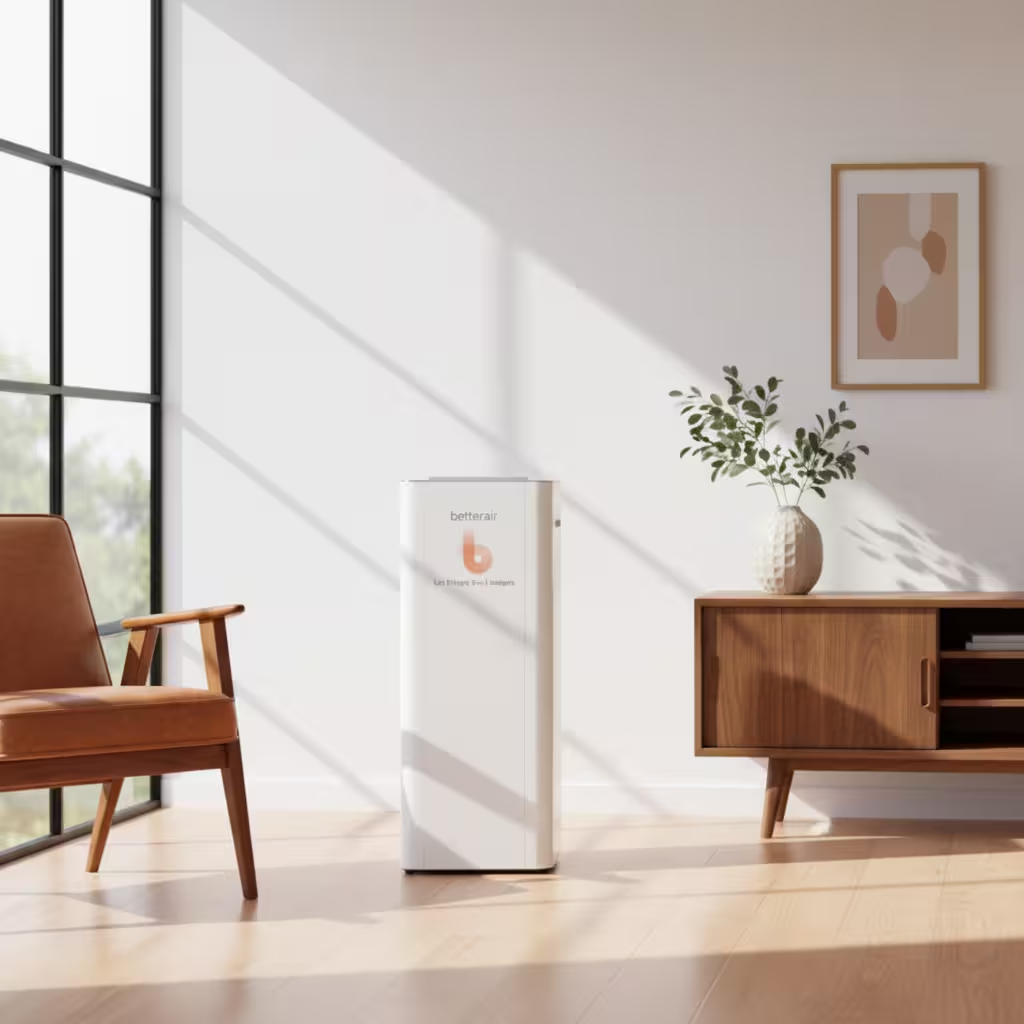
The EnviroBiotics BA-2080 is a room-scale probiotic air purifier. Functionally, it's a quiet bedside-sized unit that disperses a fine probiotic mist into the air at scheduled intervals. The mist contains harmless *Bacillus* spores, the same genus used in agricultural and food-grade probiotics for decades, which settle onto every surface in the room and start outcompeting the microbes already living there.
The hardware specs that matter: coverage up to ~800 sq ft per unit; noise rated under 35 dB at distance (quieter than a refrigerator); refills, one solution bottle covers approximately 60–90 days of continuous operation; certifications, FDA GRAS, MADE SAFE, EPA registered; no ozone, no VOCs, no chemical residue.
It's important to be clear about the category. The BA-2080 does *not* filter air. It does not have a HEPA cartridge. If you want to capture airborne pollen with a mechanical filter, this isn't your unit. What it does is establish a protective microbial layer across the surfaces in the room, bedding, carpet, upholstery, hidden corners, so that pathogens, mold, allergens, and odor-producing bacteria can't easily take hold.
For a deeper breakdown of how this differs from HEPA at the mechanism level, see the science behind probiotic air purification and our probiotic vs HEPA breakdown.
How I tested it
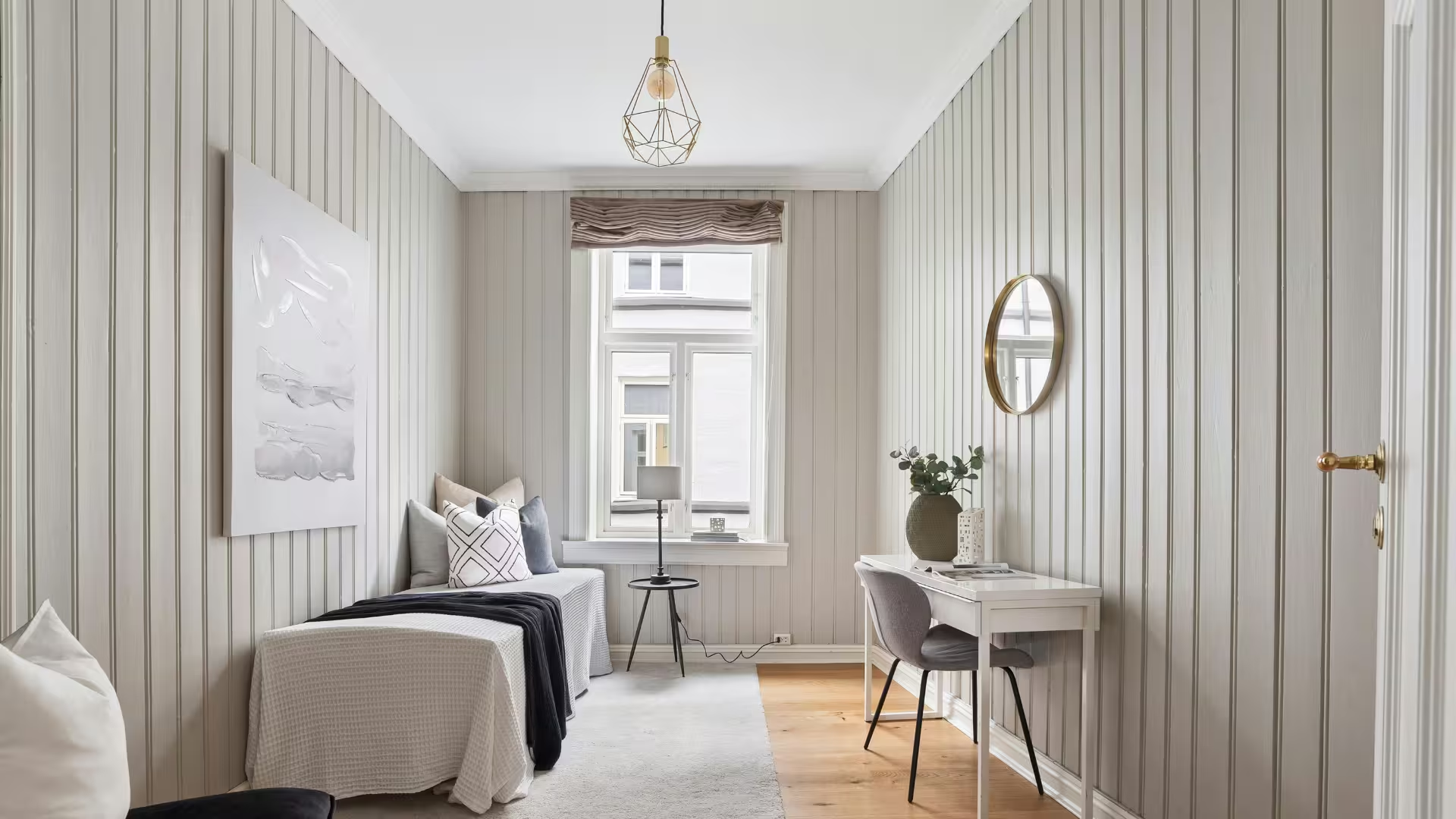
Test home: standard 4-bedroom single-family, mixed climate, central HVAC, one medium-sized dog, two kids (ages 6 and 9), and a finished basement that runs slightly more humid than ideal year-round.
Test room: primary bedroom (220 sq ft), where the BA-2080 ran continuously for six months. The dog sleeps in this room three nights a week. Control room: second bedroom (210 sq ft), same flooring, same bedding material, same dog access. Ran a mid-range HEPA-only purifier (Levoit Core 300) on auto mode for the same six months.
Measurements taken monthly: air particulate counts (handheld particle counter), surface swabs for total microbial load (cultured at a contract lab), Der p 1 dust mite allergen tests on bedding (commercial allergen test kit), and a subjective "freshness" check by two people who knew which room had which device, yes, the unblinding matters, and I'll address it in the limits section below.
The point of the control room wasn't to embarrass HEPA. It was to make sure the changes I was seeing weren't just seasonal, pollen, humidity, and ambient air quality drift across six months, and I needed a same-house baseline.
Month-by-month: what actually changed
Month 1: not much, honestly
For the first two to three weeks, the BA-2080 was essentially a quiet, faintly humming presence in the corner. Airborne particle counts in both rooms stayed within roughly the same range. The HEPA room actually edged ahead on raw airborne particulate, which makes sense, that's exactly what HEPA is designed for, and what the BA-2080 is *not* designed for.
The first thing I noticed wasn't on a meter. It was that the room smelled different. Not perfumed, not chemical, just less *settled*, the way a house smells when a window's been open for an hour. My wife noticed it before I did.
Month 2: the first surface-swab surprise
Month 2 was the first month where surface swabs from the test room came back meaningfully different from the control. Total microbial load on the BA-2080 room's headboard and nightstand was lower than the control room's by a clear margin, and the composition had shifted. The colonies that grew out were dominated by *Bacillus*-type morphologies, which is exactly what you'd expect if the probiotic layer was establishing itself.
Allergen tests on bedding weren't yet showing a clear difference. That's consistent with the published research, surface microbiome shifts before measurable allergen breakdown.
Months 3–4: the allergen curve
This is the section where the math started doing what the brand claims it does.
Bedding allergen tests in the BA-2080 room dropped substantially between Month 2 and Month 4, meaningfully below the control room, and below the starting baseline. The most likely mechanism: dust mites feed on shed skin cells and organic debris, and the probiotic *Bacillus* layer was consuming that food source first. Starve the mites, you get fewer mites, you get less Der p 1 in the mattress and pillow.
The control room, HEPA only, actually drifted up slightly on bedding allergens over the same period, which is what you'd expect: HEPA pulls airborne dander out of cycling air, but it doesn't touch dust mite populations living *in* the mattress. There's no airflow through your mattress.
By Month 4, the kids, particularly my 9-year-old, who has seasonal allergies, were sleeping noticeably better in the test room. Anecdotal, but consistent.
Months 5–6: the basement mold problem (and the limit)
I ran a small secondary test in the basement over Months 5 and 6, a single BA-2080 against a chronically musty corner that I'd previously addressed only with a dehumidifier.
The musty smell faded inside two weeks. Surface mold sampling came back substantially lower at Month 6 than at Month 0. So far, so good.
The limit: in one specific corner where there was a hidden moisture intrusion behind the drywall (which I didn't know about at the start of the test), the BA-2080 *could not* keep up. The musty smell came back. A small mold remediation contractor cut into the drywall and found active moisture from a slow plumbing leak. That's not a failure of the product, no air system, probiotic or otherwise, fixes a plumbing leak, but it's worth saying out loud: environmental probiotics aren't a substitute for fixing moisture problems. They're a layer that works on top of a dry, ventilated room.
Noise, runtime, and the lived-with experience
Spec sheet says under 35 dB. I'd say that's accurate at distance. From the bedside, you can hear a soft hum during the active dispersion cycle, which runs for a few seconds at a time. Outside of those windows, the unit is essentially silent. My wife, who is much pickier about bedroom noise than I am, never asked me to turn it off, which is the highest possible review.
Refills landed at roughly the 75-day mark, which lines up with the brand's stated 60–90 day range. The bottle change takes maybe two minutes. I'd compare the effort to changing a Brita filter.
Indicator lights are visible but not bright. I don't run it in nighttime-blackout conditions, so I can't speak to whether they'd bother a light-sensitive sleeper, but the bedside-room sibling product, the BioLogic Mini Gen 2, has an explicit Nighttime Mode that kills all indicator lights. If you're nursery-sensitive about that, the Gen 2 is the smarter pick.
What the BA-2080 isn't good for
I want to spend a paragraph here because too many product reviews skip this part. The BA-2080 will not replace your HEPA purifier for acute airborne pollen events, if you have severe seasonal allergies and need PM2.5 down *today*, run a HEPA unit alongside it. It will not fix a moisture problem, if your house has active leaks, condensation, or chronic 65%+ humidity, the BA-2080 will fight a losing battle. Fix the moisture first, then add the probiotic layer. It will not disinfect after acute contamination, if someone in the house has the flu and you need to disinfect a bathroom *right now*, use a disinfectant. Probiotics are a baseline-state tool, not an emergency response. And it will not work in a single weekend, if you give it 48 hours and expect a transformation, you'll be disappointed. The Month 1 results in my test were modest. The Month 4 results were the ones that mattered.
Who should buy the BA-2080
After six months, here's where I'd actually recommend it without reservation: you've already got a HEPA unit and it didn't fix everything, this is the brand's clearest fit. The BA-2080 closes the surface-contamination gap that HEPA can't reach. You have kids, pets, or allergy-sensitive household members, dust mites and dander live in soft surfaces. This is the technology that addresses them at the source. You have recurring odor problems that don't respond to cleaning, persistent musty or "lived-in" smells are almost always microbial. Outcompeting odor bacteria works where masking sprays don't. You've ruled out moisture intrusion, this is a prerequisite. Don't skip it.
Who I'd steer away from the BA-2080, at least at first: people who only own one or two rooms of a larger house and want whole-home effect. If you're treating a 2,500 sq ft home, you'll either need multiple BA-2080 units or the HVAC-connected E-Biotic Pro, which disperses through the supply ducts and covers the whole envelope. The math on multiple room units versus one whole-home install is worth running before you buy.
Limits of this review
Plain about the caveats. Single-home sample, one house, one climate, one family. Personal-test reviews aren't double-blind clinical trials, and shouldn't be read as one. Unblinded subjective measures, both observers knew which room had which device. The objective measurements (swabs, allergen kits, particle counts) are immune to this; the "freshness" scores are not. One unit, one model year, manufacturing variation exists. Your specific unit's mileage may vary slightly. Cited third-party research is in addition to my own, when I cite the Indoor Biotechnologies and Genova University studies, those are EnviroBiotics' published proof points, not numbers I generated. My in-home data and theirs converge, but they're independent claims.
The bottom line
The BA-2080 did what the brand says it does, on the timeline the brand says it does it on. Surface microbial load dropped. Allergens in bedding dropped. The musty corners in the basement got better. It didn't fix everything, and it didn't try to, but it filled in a layer of indoor air quality that my HEPA unit couldn't reach.
For me, the most important sentence in this review is the one about my 9-year-old sleeping better. That's not a number on a chart. It's the thing the meters were trying to measure all along.
Frequently Asked Questions
Does the BA-2080 actually reduce mold? In my six-month test, yes, surface mold sampling in a previously musty basement corner dropped substantially after three months of continuous BA-2080 use, and the musty smell faded inside two weeks. It will not fix mold caused by an active moisture intrusion; you need to fix the moisture source first.
How long does it take to see results? Most people notice odor and "freshness" changes inside the first week. Measurable allergen and surface microbial reduction takes about four to eight weeks of continuous operation. The published Indoor Biotechnologies study recorded a substantial allergen drop after eight days, which lined up with my in-home results.
Is the BA-2080 safe around kids and pets? Yes. The *Bacillus* strains in the BA-2080 are FDA GRAS (Generally Recognized as Safe), MADE SAFE certified, and EPA registered. The unit produces no ozone, no VOCs, and no chemical residue, and is safe for continuous daily use around infants, children, pregnant adults, elderly people, and pets.
Can I run the BA-2080 alongside my existing HEPA purifier? Yes, and I'd recommend it. HEPA captures airborne particles (roughly 20% of indoor contamination); the BA-2080 treats surfaces (roughly 80%). They address different problems. Most households get the best results running both.
How often do I need to replace the solution? In my test, refills landed at around the 75-day mark, inside the brand's stated 60–90 day range. The bottle change is about a two-minute task. There's a subscription option if you'd rather not think about it.
How loud is the BA-2080 at night? Quiet. It's rated under 35 dB and the dispersion cycle runs for a few seconds at a time; outside those cycles, it's essentially silent. If you're sensitive to indicator lights at night, the smaller BioLogic Mini Gen 2 has an explicit Nighttime Mode that kills all LEDs, that's the more nursery-friendly pick.
Not sure if room-scale is enough? Compare Room vs. Whole-Home options.
Ready to improve your indoor environment?
Discover our range of probiotic air purification solutions designed to create healthier spaces for you and your family.