
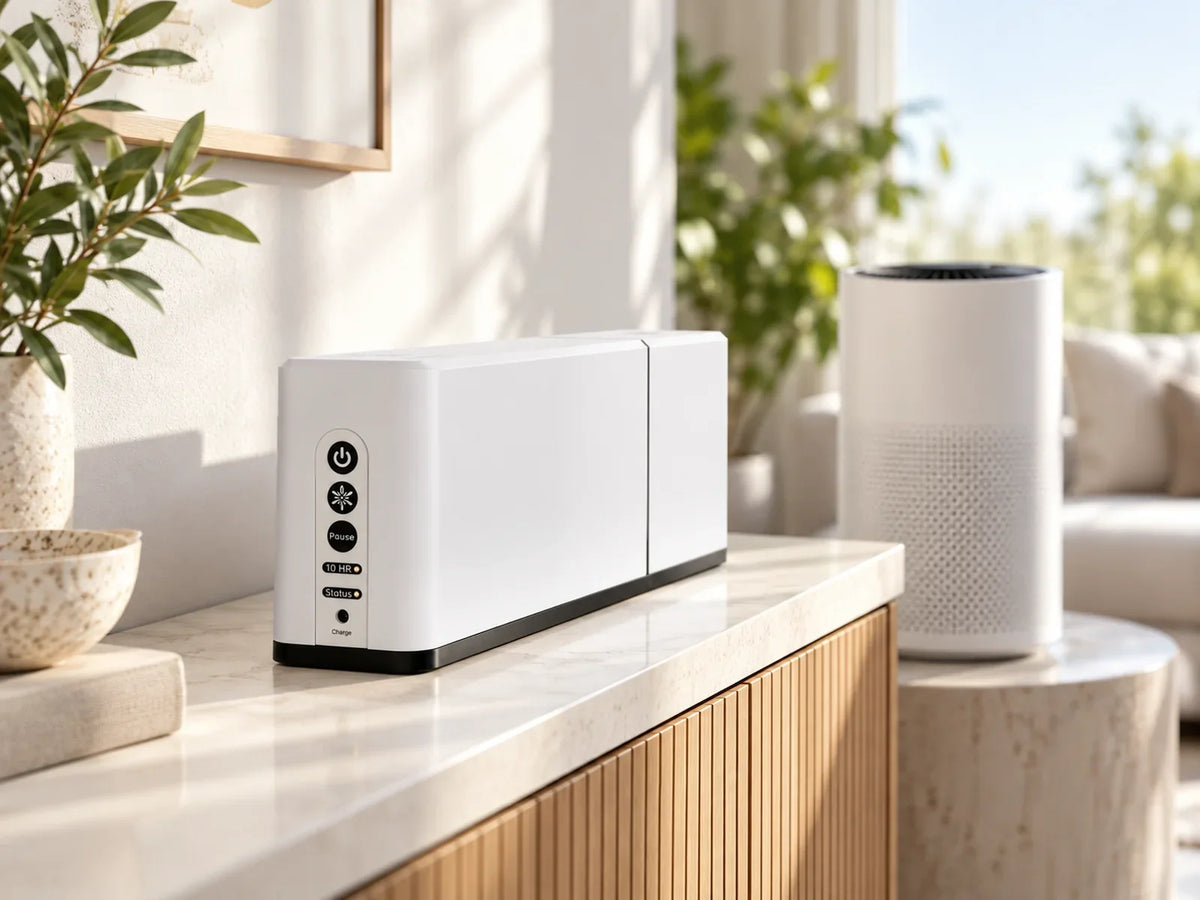
Quick answer: Molekule and EnviroBiotics are both premium, non-HEPA approaches to indoor air, but they work on different problems. Molekule uses PECO (Photo Electrochemical Oxidation) to break down airborne molecules, such as VOCs and odor compounds, as air passes through the unit. EnviroBiotics releases natural probiotics that settle on the soft surfaces where odor lives, such as sofas, rugs and pet beds, and keep working there every day. Molekule is aimed at airborne chemical pollutants; EnviroBiotics is aimed at the surfaces. They cover different halves of the same room.
This comparison looks at how each one works, where each one stops, and which fits which problem.
Why this comparison is worth doing carefully
Most air purifier comparisons are HEPA versus HEPA: the same technology at different prices and fan speeds. Molekule and EnviroBiotics are interesting because neither is HEPA. Both start from the same observation: trapping particles in a filter is not the whole answer.
Molekule made that argument loudly. Its marketing premise was that a HEPA filter captures pollutants without breaking them down. Whatever you think of the execution, that message taught many premium buyers that capture alone is not enough.
EnviroBiotics starts in the same place and takes it one step further. Capture is not enough, and neither is treating only the air, because much of what makes a room smell stale has already settled into fabric. So this is not an attack piece. It is a comparison between two brands that agree on the diagnosis and differ on the treatment. See the probiotic vs HEPA comparison for the wider technology context.
How Molekule's PECO works
Molekule's core technology is PECO, Photo Electrochemical Oxidation. Here is the plain-English version.
Air is pulled into the unit and passes over a filter coated with a catalyst. A light source activates that catalyst, which triggers an oxidation reaction at the filter surface. According to Molekule, airborne molecules that touch that surface, such as VOCs and odor compounds, are broken down into smaller, simpler molecules.
The pitch is that instead of trapping a pollutant in a filter you later throw away, PECO breaks it down. For airborne chemical pollutants, such as cooking odors, off-gassing from furniture and paint, or smoke compounds, that is a useful idea.
Where does PECO stop? Where every air-processing technology stops: it can only act on air that moves through the unit. A molecule has to be airborne and has to pass over the catalyst for anything to happen to it. That is not a flaw in PECO. It is simply what an in-line air treatment is.
How EnviroBiotics works on surfaces
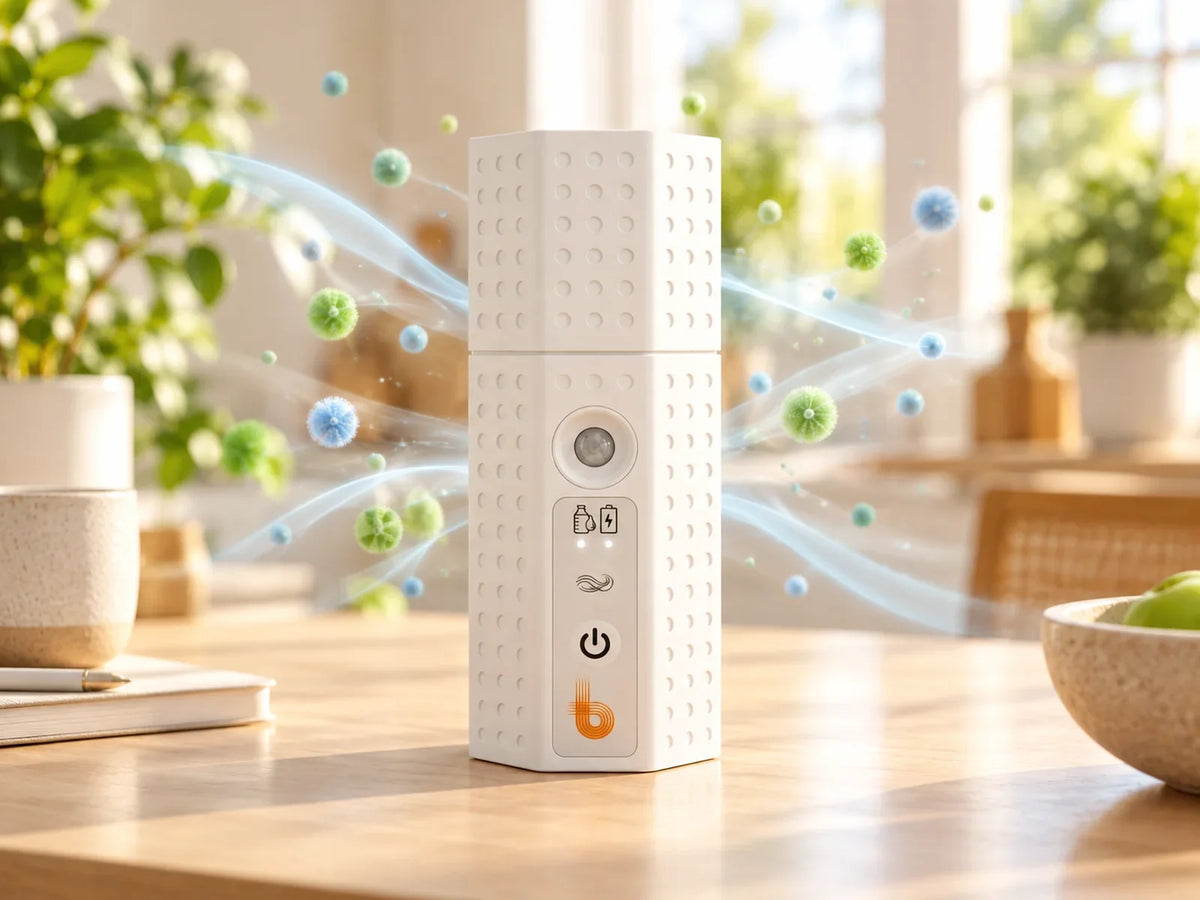
EnviroBiotics does not push air through a box. It releases natural probiotics into the room, where they settle onto surfaces and stay there.
Once on a surface, the probiotics do something a filter or an oxidizer cannot. They feed on the organic residue (shed skin, food traces, dust, dander) that odor-causing bacteria depend on, and they take up the space those bacteria would otherwise use. This is competitive exclusion, the same principle that helps a healthy gut microbiome hold its ground. The practical result: fewer odor-causing bacteria on the surfaces where odor lives.
That matters because much of what people notice indoors, the smell that comes back, the dander in the couch, settles into the mattress, the carpet, the upholstery and the curtains. Molekule works on the air. EnviroBiotics works on that settled layer. Those are different targets.
There is published research on the surface side:
- In a 2024 study by Indoor Biotechnologies (Cardiff, UK), an 8-day controlled application showed a cumulative decrease in dust-mite, pet-dander and mold allergens, with a parallel simulation at EMSL Analytical (NJ).
- In a 2025 study at the University of Genova, Department of Experimental Medicine, the EnviroBiotics probiotic suspension showed 67% SARS-CoV-2 neutralization in 15 minutes and 97.7% in 3 hours, compared with untreated controls.
Probiotics take about 2–3 weeks to settle across a room, and they work alongside regular cleaning, not instead of it.
Head to head
Here is the side-by-side, matching Molekule's premium room units against the EnviroBiotics Biotica 800, since both are premium room-scale devices.
| Molekule | EnviroBiotics (Biotica 800) | |
|---|---|---|
| Core mechanism | PECO oxidation of airborne molecules | Natural probiotics that settle on surfaces |
| Primary target | Airborne VOCs and odor compounds | Odor-causing bacteria on soft surfaces |
| Acts on air | Yes, as air passes through | Indirectly: the mist travels through the air to settle |
| Acts on surfaces | No | Yes, that is its main job |
| Best at | Cooking and chemical odors, off-gassing | Smells that come back from sofas, rugs, pet beds and curtains |
| Coverage | Room-scale | Up to 800 sq ft |
| Consumables | Periodic PECO filter replacement | Probiotic cartridge, up to about 90 days; no filters |
| Credentials | Brand's own testing and claims | EPA registered, MADE SAFE certified |
| Price tier | Premium | $299 |
Look at the "best at" row; that is the whole story. Molekule's strengths are about airborne chemistry. EnviroBiotics' strengths are about the surfaces where smells and allergens settle. There is very little overlap, which is why treating them as rivals misses the point.
What each one is genuinely best for
Choose Molekule if your main concern is airborne chemical pollution. New-furniture off-gassing, strong recurring cooking odors, sensitivity to VOCs: these are airborne problems, and treating air as it circulates is a sensible way to approach them.
Choose EnviroBiotics if your main concern is the stuff that keeps coming back. A musty smell that returns after you air the room out. Pet odor in the couch. A stale smell in the rug. Those live on surfaces, and airborne treatment does not reach them. You have to work where the odor lives. That is what probiotics do.
Choose both if you want both halves covered. They do not conflict. An air unit handling airborne VOCs and a probiotic device working on the surfaces cover two different parts of the problem. If budget allows and your home is demanding, running both is a reasonable setup, because the mechanisms do not overlap.
Can you use them together?
Yes, with one practical note. Molekule pulls air through itself continuously. If you put the EnviroBiotics device right beside its intake, some of the probiotic mist will be drawn in before it can settle on surfaces, where you want it. Give them some distance: place the probiotic device across the room from the air unit's intake.
The same applies to running EnviroBiotics next to any device that moves air, including HEPA units. The probiotic vs HEPA comparison covers placement in more detail.
The honest verdict
If you are picking one, the right choice depends on what is actually bothering you.
If it is airborne (odors from cooking, VOCs, off-gassing), Molekule's PECO is built for that.
If it is persistent and surface-based (a musty smell, pet odor, a room that never quite smells fresh), EnviroBiotics is the one of the two that works on the surfaces, and it is EPA registered and MADE SAFE certified.
Molekule got one big thing right and said it loudly: capturing pollutants is not enough. EnviroBiotics agrees, and adds that treating only the air is not enough either, because much of what people notice has already settled. Both are premium, both are non-HEPA, and they are aimed at different targets in the same room.
Frequently Asked Questions
Is EnviroBiotics or Molekule better?
Neither is better across the board; they work on different problems. Molekule's PECO is designed to break down airborne molecules like VOCs and odor compounds as air passes through. EnviroBiotics releases natural probiotics that settle on surfaces and reduce odor-causing bacteria there. For airborne chemical pollution, look at Molekule; for smells that keep coming back from soft surfaces, look at EnviroBiotics.
What is Molekule's PECO technology?
PECO stands for Photo Electrochemical Oxidation. Air passes over a catalyst-coated filter activated by light, and airborne molecules that touch the activated surface are broken down by oxidation rather than simply trapped. It can only act on air that passes through the unit; it does not treat surfaces.
Does Molekule treat surfaces?
No. Like any in-line air treatment, Molekule only acts on air that moves through the device. It does not reach what has settled on mattresses, carpets, upholstery and curtains. Working on those surfaces needs a different approach, such as natural probiotics.
Can I use Molekule and EnviroBiotics together?
Yes, and they complement each other because they work on different targets. Just do not put the probiotic device right next to the air unit's intake, or some of the mist will be pulled in before it settles. Place them on opposite sides of the room.
Is EnviroBiotics a good Molekule alternative?
It depends on what drew you to Molekule. If it was the idea of going beyond simple filtration, EnviroBiotics extends that idea to surfaces. If your specific need is treating airborne VOCs as they circulate, EnviroBiotics is not a direct substitute; the two are better seen as complementary.
Do Molekule or EnviroBiotics produce ozone?
Molekule states that PECO is not an ozone-based technology. EnviroBiotics releases a probiotic mist, not ozone, and adds no fragrance. That sets both apart from some ionizing air purifiers.
Which suits homes with kids and pets?
Both are designed for continuous home use. EnviroBiotics is EPA registered, MADE SAFE certified and PTPA parent-tested, with no fragrance. Use it as the label directs.
Where EnviroBiotics fits
If the smell keeps coming back from the sofa, the rug or the pet bed, the air is not the whole story. EnviroBiotics releases natural probiotics that settle on those surfaces and keep working every day, with no filters and no fragrance. Start with the BioLogic Mini for a smaller room or the Biotica 800 for larger spaces, or see how it works.

Leave a comment
This site is protected by hCaptcha and the hCaptcha Privacy Policy and Terms of Service apply.