Purification vs Disinfection: Why Killing Germs Isn't Making Your Indoor Air Healthy
Disinfectants, HEPA, and UV all fall short indoors. Here's why probiotic purification is the only true whole-environment approach to indoor air quality.
Key Takeaways
- Probiotic technology creates a healthier microbial balance
- 24/7 protection on surfaces throughout your space
- Natural and sustainable alternative to chemical cleaners
- Works with nature to create safer indoor environments
Quick answer: Disinfecting an indoor space kills microbes for a few minutes, and then leaves a sterile surface that pathogens recolonize first, because they reproduce faster than the protective microbes you wiped out. True purification works the opposite way: it maintains a healthy microbial ecosystem so harmful organisms never get a foothold. That's the difference between probiotic air purification and conventional disinfectants, HEPA filters, UV-C, and ionization.
The 19th-century playbook is still running your home
Most of how we clean indoor spaces today comes from a model that's about 150 years old: kill the germs, then kill them again tomorrow.
Bleach. Quats. Alcohol wipes. UV lamps. Ionizers. They all sit on the same assumption, that a sterile surface is a safe surface. And for a long time, nobody questioned it, because it sounds right. Fewer germs = less risk. What's the problem?
The problem is what happens about 20 minutes after the wipe dries.
Modern microbiology has been pretty clear on this for over a decade: a stable, diverse microbial community is what actually keeps pathogens from taking over. Strip that community out, and you don't get a clean room. You get a vacant lot. And in a vacant lot, the fastest, hardiest organism wins, which, in indoor environments, is almost never the one you want.
This is why hospitals, gyms, cruise ships, and schools end up locked into chronic reinfection cycles despite cleaning more than anyone else. It's not that they aren't cleaning hard enough. It's that the cleaning itself is part of the loop.
Why "kill it all" backfires
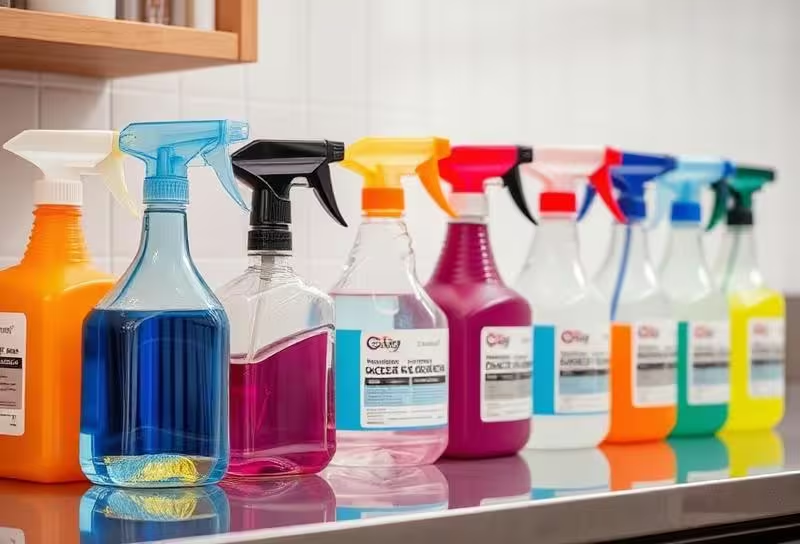
Here's the cycle, in plain English: you spray a surface with a chemical disinfectant. The disinfectant kills most of what's living there, the harmful microbes and the harmless ones competing for the same space. Within minutes, the surface is recolonized. The first microbes back are the ones that reproduce fastest. Pathogens are very good at reproducing fast. Over time, those pathogens form biofilms, sticky microbial mats that resist the next round of chemicals. You spray more, more often, with stronger chemicals. Resistant strains emerge. Repeat.
This isn't a hypothesis. It's why the CDC tracks antimicrobial resistance as one of the top public health threats of the decade, and why over-sanitization is now a recognized contributor to chronic indoor-air problems.
There's a stat we keep coming back to because nothing else captures the issue as cleanly: roughly 80% of indoor allergens, mold spores, pet dander, and bacteria live on surfaces, not floating in the air. A purifier that only treats air is solving 20% of the problem. A disinfectant that wipes a surface for 30 seconds is solving the other 80% only until the next person walks through the room.
"You don't get safety from disinfection. You get dependency on it.
What probiotic purification actually does
The probiotic approach borrows the same idea your gut runs on, your skin runs on, and healthy soil runs on: competitive exclusion.
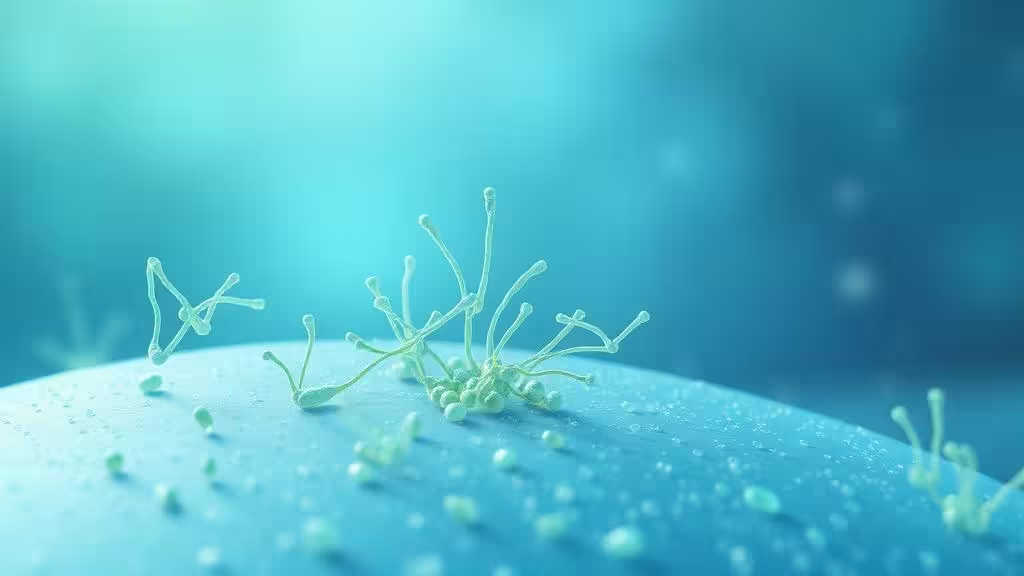
Beneficial Bacillus spores, the same harmless soil microbes used in agriculture and food production for decades, are released as a fine mist into a room or through an HVAC system. They settle on surfaces. They occupy the microscopic real estate that pathogens need. They consume the organic debris (skin cells, food residue, pet dander, mold food) that pathogens would otherwise feed on. They don't poison anything. They just outcompete it.
Three things to know about Bacillus used this way: It's FDA GRAS, MADE SAFE certified, and EPA Registered, safe around infants, kids, pets, and immunocompromised people. It produces no ozone, no VOCs, and no chemical residue, nothing to ventilate out, nothing accumulating in soft surfaces. It works in the places line-of-sight technologies can't reach, carpet fibers, the undersides of furniture, the deep ductwork. Anywhere a microbe can hide, the probiotic can settle.
This is the mechanism behind the whole-home E-Biotic Pro system and the room-scale BioLogic Mini Gen 2. Same biology, different delivery.
How probiotic purification compares to HEPA, UV-C, and ionization
Most of the indoor-air market is built around three technologies. Each one does something useful. None of them does the whole job. Here's the honest version of each.
HEPA filters: vacuuming the air
HEPA is excellent at what it does, pulling particles out of the air that's currently passing through the filter. If you've got a Levoit, a Coway, a Blueair, or a Molekule running, you're catching pollen, dust, and a meaningful share of airborne bacteria as that air cycles through.
What HEPA doesn't do: treat any surface in the room, stop pathogens from reproducing once they've landed somewhere, break down the allergens already embedded in your carpet, sofa, or bedding, or protect anything between cycles.
If you've got a HEPA unit, keep it. It handles the airborne 20%. The probiotic layer handles the surface-bound 80%. They're complementary, see the full breakdown on probiotic vs HEPA.
UV-C: line-of-sight killing
UV-C is genuinely lethal to microbes, if the microbes pass directly through the beam, or sit on a surface the lamp can shine on. It's why you'll see UV-C in some HVAC coil setups and in upper-room fixtures in clinical environments.
Outside that narrow window, it does very little. UV doesn't bend around furniture. It doesn't penetrate fabric. It doesn't reach deep into ductwork. And the moment you turn it off (or step out of its range), recolonization starts immediately. Worse, certain UV setups can produce ozone as a byproduct, which is its own respiratory irritant.
UV creates sterile zones inside non-sterile rooms. The probiotic approach makes the whole room less hospitable to pathogens at the same time.
Bipolar ionization: chemical oxidation indoors
Bipolar ionization releases reactive oxygen species (charged ions) into the air. They oxidize particles, including the ones you'd rather not breathe.
The problem: oxidation doesn't discriminate. The same chemistry that breaks down a virus particle also irritates lung tissue, contributes to indoor ozone and aldehyde formation, and degrades indoor air chemistry over time. The science on its real-world efficacy has gotten less flattering over the last few years; the science on its byproducts has not gotten better.
The probiotic approach does the opposite of oxidation. It uses biological competition, the same mechanism that's kept ecosystems balanced for several billion years, instead of chemical warfare in your living room.
What the research actually shows
Probiotic environmental control isn't a startup pitch, it's been deployed at scale in regulated environments for years (this is the part of EnviroBiotics' history that used to live under the BetterAir name; see our story for the full timeline).
Genova University, Department of Experimental Medicine found that viruses on objects and surfaces were neutralized by 67% within 15 minutes and 97.7% within 3 hours of probiotic exposure. A study by Indoor Biotechnologies measured allergen concentration in continuously treated rooms and recorded a substantial drop after just 8 days of use. Independent lab tests on the current product line show measurable allergen and pathogen reduction within 30 days of continuous operation. The same systems are in use at hospitals, nursing homes, schools, food processing plants, and large commercial buildings, environments where reinfection cycles are expensive and visible.
Where this matters most
Probiotic purification isn't the right tool for every problem. If you need to disinfect a single contaminated surface right now, a kitchen counter after raw chicken, a bathroom after illness, use a disinfectant. That's what they're for.
What probiotic purification is for is the baseline: the continuous, low-level state of the indoor environment you live in for 22 hours a day. The contexts where the difference shows up most: homes with kids, pets, or allergy-sensitive people, the 80%-on-surfaces problem hits hardest in environments with fabric, carpet, and warm bodies constantly redistributing organic matter. Older homes with central HVAC, ducts are the part of your house that never gets cleaned. They're also where biofilms quietly build up. A whole-home probiotic system treats the duct interior continuously. Spaces where odors keep coming back, persistent musty, pet, or "old building" smells are almost always microbial. Killing the smell-producing organisms with a candle or spray is symptomatic. Outcompeting them at the source is structural. People who've already tried HEPA and feel nothing changed, this is the most common story we hear. The HEPA didn't fail; it just couldn't reach the part of the problem that mattered.
The bottom line
Disinfection is a reaction. You wait for contamination, then you respond to it. Purification, the real kind, is a system. You change what grows in the building, so the contamination has nowhere to take hold in the first place.
HEPA, UV, and ionization try to remove or kill particles. They're useful tools, with real limits. Probiotic air purification changes the question entirely: not how do we kill the pathogens? but how do we make the environment one where pathogens lose? That's the shift. That's the difference between cleaning air and making the indoor environment healthy.
Frequently Asked Questions
Is probiotic air purification safe for babies and pets? Yes. The Bacillus strains used in EnviroBiotics products are FDA GRAS (Generally Recognized as Safe), MADE SAFE certified, and EPA Registered. They produce no ozone, no VOCs, and no chemical residues, and are safe for infants, children, pregnant women, elderly people, and pets in continuous daily use.
Do probiotic air purifiers actually work, or is this marketing? They work, but through a different mechanism than people expect. Instead of filtering or killing, they outcompete pathogens for surface space and food. Independent studies have shown 67% reduction of viruses on surfaces within 15 minutes and 97.7% within 3 hours, plus measurable allergen reduction within 8 days of continuous use.
Can I use a probiotic air purifier alongside my existing HEPA filter? Yes, they're complementary, not redundant. HEPA captures airborne particles passing through the unit (~20% of indoor contamination). Probiotic purification treats surfaces and HVAC ducts where the other ~80% lives. Most homes get the best results running both.
Will probiotic purification replace cleaning? No, and we wouldn't recommend that. It replaces the chemical disinfecting layer of cleaning, the part that strips your home's microbiome and creates dependency, but normal cleaning (vacuuming, dusting, wiping spills) still matters. Think of it as the layer that works between cleanings, not instead of them.
What's the difference between probiotic purification and bipolar ionization? Both claim to treat the whole room. Bipolar ionization treats the room by oxidizing particles in the air, which can also oxidize lung tissue and produce ozone or aldehyde byproducts. Probiotic purification treats the room by establishing a living microbial layer that consumes pathogen food sources. One is chemistry; the other is biology, and only one is safe to breathe long-term.
How long until I notice a difference? Most users notice odor and "freshness" changes within the first week. Measurable allergen and pathogen reduction takes about 30 days of continuous operation. Whole-home HVAC-installed systems like the E-Biotic Pro show the largest cumulative effect because they treat the entire building envelope, not just one room.
Not sure which system fits your space? Compare Room vs. Whole-Home options.
Ready to improve your indoor environment?
Discover our range of probiotic air purification solutions designed to create healthier spaces for you and your family.
Add EnviroBiotics as a preferred source
Get our latest research, guides, and air-quality insights highlighted in your Google experience.