How to Get Rid of Musty Smell in Your House: The Probiotic Approach That Lasts
Musty smells return because odor bacteria live on surfaces. Here's the natural, probiotic approach that eliminates the source, plus the quick fixes that help.
Key Takeaways
- Probiotic technology creates a healthier microbial balance
- 24/7 protection on surfaces throughout your space
- Natural and sustainable alternative to chemical cleaners
- Works with nature to create safer indoor environments
Quick answer: Musty smells come from microbes feeding on damp organic material, usually mold, mildew, and odor-producing bacteria living on porous surfaces like wood, drywall, carpet, and upholstery. To get rid of musty smell in your house: find and fix the moisture source, dehumidify to 40–60% relative humidity, ventilate daily, deep-clean affected surfaces, and treat them with environmental probiotics so the odor microbes can't recolonize. Masking sprays don't work because they don't touch the source.
Why musty smells keep coming back
A musty smell isn't a smell of dirt. It's a smell of biology. Specifically, it's a class of compounds called microbial volatile organic compounds (MVOCs), gases produced by mold, mildew, and certain bacteria as they grow on damp surfaces. The earthy-basement, old-book, wet-towel smell you can't quite locate is the byproduct of an active microbial community somewhere in the room.
Which means three things: Spraying air freshener doesn't fix it. You're masking MVOCs with stronger fragrance compounds. The microbes are still there, still growing, still producing odor. Stop spraying and the smell comes back. A quick wipe with a disinfectant doesn't fix it either. You'll kill the surface population for a few hours, but porous materials hold moisture and food deeper than a wipe can reach. The same microbes recolonize within days. The smell keeps coming back because the *conditions* that produced it keep coming back. If the wood under your sink is damp because of a slow leak, no amount of cleaning makes the smell go away until the leak is fixed.
The lasting fix isn't chemistry. It's environment. You change the conditions, then you change what grows there. That's the entire game.
Before we get to the protocol: if you're chasing a smell specifically tied to visible mold, best air purifier for mold covers that scenario in more depth. This guide is for the general "the house smells musty and I can't figure out why" problem.
Quick fixes (and what they don't do)
Almost everyone tries these first. They're not useless, they buy you time and they help, but none of them is a structural fix. Worth running, in this order, while you're setting up the real fix.
Open windows for 15–30 minutes on opposite sides of the house. Cross-ventilation pushes the MVOC-laden indoor air out and replaces it with outdoor air. The smell will fade for a few hours. Run the bathroom and kitchen exhaust fans. Even if the source isn't in those rooms, you're creating pressure differentials that move air. Put bowls of activated charcoal in the affected room. Charcoal adsorbs MVOCs. Cheap, effective for moderate odor loads. Replace every 1–2 months. Place open boxes of baking soda in closets and around carpeted areas. Less effective than charcoal for active odor, but useful as a baseline. Wash all soft surfaces in the room, bedding, curtains, rugs, throw pillows. Use hot water where the fabric allows. Run a dehumidifier if you have one. This is also Step 2 of the real protocol, so it's the most consequential quick fix on this list.
Now the part most people miss.
Why the smell keeps coming back
Here's the cycle nobody warns you about.
You spray an air freshener. The room smells nice for two hours. The MVOCs are still being produced, you just can't smell them under the cherry-blossom mask. The next day you spray again. The microbes adapt to the slightly altered surface chemistry. The smell creeps back faster every time.
You wipe surfaces with a disinfectant. The visible surfaces get clean. The porous material underneath (carpet pad, drywall, the seam between baseboard and floor) is still damp and still hosting the same microbial community. Within 24–72 hours, the surface is recolonized, and because you've wiped out the harmless competing microbes along with the harmful ones, the species that comes back first is whichever one reproduces fastest. Usually that's the same odor-producer.
This is why people end up cleaning the same room three times a week and never fixing the smell. Each round of disinfection resets the surface microbiome and lets the fastest-reproducing organism win again.
The fix is the inverse: create surface conditions where harmless microbes get to the food and space first, and the odor-producing ones don't get a foothold. That's competitive exclusion, the same mechanism your gut microbiome uses, applied to indoor surfaces.
The probiotic protocol (5 steps)
This is the actual fix. Order matters.
Step 1: Find and fix the moisture source
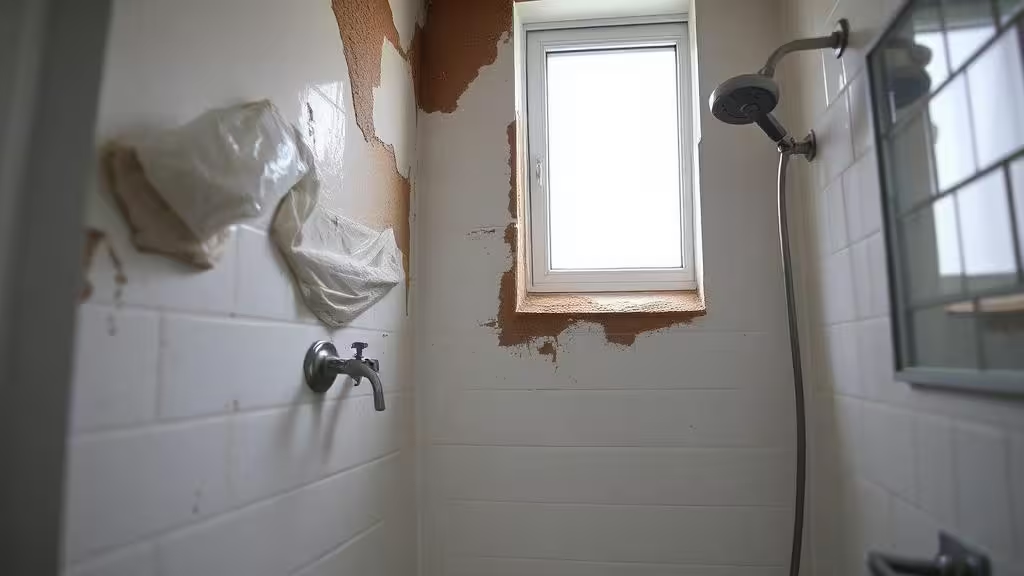
This is the step everybody wants to skip and nobody can skip. Musty smell = active microbial growth = active moisture, somewhere. Common culprits: plumbing leaks under sinks, behind toilets, in walls behind washing machines and dishwashers; roof leaks showing up in attic spaces, top-floor ceilings, or behind dormers; foundation moisture in basements and crawlspaces (look for efflorescence, white powdery deposits, on concrete); HVAC condensation from underinsulated ducts or a clogged condensate drain; window condensation in older single-pane windows or poorly insulated frames; a wet carpet pad from a one-time flood that was surface-dried but never lifted.
If you don't find an obvious source, get a cheap moisture meter ($25 at a hardware store) and walk it around suspect walls and floors. Anything reading meaningfully wetter than its neighbors is a candidate.
Don't proceed past Step 1 until the source is fixed. Every later step is fighting a losing battle if the underlying material is staying wet.
Step 2: Dehumidify to 40–60% RH
Buy a hygrometer if you don't have one ($15). Buy a dehumidifier appropriate to the affected room size if your humidity reads above 60%.
Targets: main living areas: 40–60% RH; basements and crawlspaces: 50% RH or lower; bedrooms: 45–55% RH (the comfortable mid-range). Run continuously until the reading stabilizes for a week.
Step 3: Ventilate daily
Daily cross-ventilation, 15–30 minutes. Morning is best (lowest outdoor pollen). Run kitchen and bathroom exhaust fans during use. If you have a whole-house ventilation system or HVAC with a fresh-air intake, set it to run on a schedule rather than only when heating or cooling.
Step 4: Deep-clean affected surfaces (once)
After moisture is fixed and humidity is controlled, do a single thorough cleaning of the affected room. Vacuum thoroughly (HEPA-bag vacuum if you have one, regular if you don't). Steam-clean carpet and upholstery if practical. Wash all soft goods. Wipe hard surfaces with a mild, fragrance-free cleaner.
Do this once. Resist the urge to repeat the deep-clean weekly, that's where the over-disinfection trap kicks in, and it's why so many "clean houses" still smell musty. (For the longer argument on this, see over-sanitization is its own problem.)
Step 5: Apply environmental probiotics
This is the structural fix. After moisture, humidity, and ventilation are in place and the room has been deep-cleaned once, install an environmental probiotic system in the affected space.
The mechanism is straightforward: the unit disperses a fine mist of beneficial Bacillus spores into the room at intervals. The spores settle onto surfaces, consume the organic debris that odor-producing microbes feed on, and occupy the space those microbes would otherwise colonize. Within days to weeks, the surface microbiome shifts toward the harmless probiotic strains and away from the odor-producers.
What to expect, in plain language: Week 1: mild "fresher" sensation; the acute musty smell often softens noticeably. Weeks 2–4: sustained reduction; people stop walking into the room and asking what the smell is. Month 2 onward: background state; if you've fixed the moisture problem, the smell shouldn't return as long as the probiotic system stays running.
Room-scale options that fit this protocol: BioLogic Mini Gen 2 for rooms up to ~300 sq ft (closets, bedrooms, smaller basements, nurseries), ultra-quiet and has a Nighttime Mode that turns off indicator lights. Biotica 800 for rooms up to ~800 sq ft (larger basements, family rooms, open-plan spaces). For whole-house musty problems, where the smell isn't localized to one room and you suspect HVAC contamination, the E-Biotic Pro disperses probiotics through your existing supply ducts and covers up to 25,000 sq ft.
The technology is FDA GRAS, MADE SAFE certified, and EPA Registered. No ozone, no VOCs, no chemical residues. Safe to run around infants, kids, and pets continuously.
When to call a professional instead
The protocol above handles general musty smells in homes without major mold infestations. Some situations need a remediation professional, not a DIY approach: visible black or dark green mold patches larger than about 10 square feet (EPA guidance says this size threshold warrants professional remediation, don't disturb it yourself); persistent musty smell with no findable source (hidden mold behind drywall, under flooring, or inside HVAC equipment may require thermal imaging or invasive inspection); health symptoms tied to the room, worsening allergies, respiratory irritation, headaches that resolve when you leave the house; post-flood or post-water-intrusion homes within the first 48 hours (wet drywall and insulation that stayed saturated more than 48 hours typically needs to be removed, not dried).
Environmental probiotics complement professional remediation; they're not a substitute for cutting out actively growing mold in a wall.
The bottom line
Musty smells are biology, not air. You can't out-spray them, you can't out-clean them, and you can't out-purify them with a HEPA filter that never touches the surfaces where the odor-producers actually live. What works is changing the underlying conditions (moisture, humidity, ventilation) and then changing what grows on the surfaces, by giving the harmless microbes the first crack at the space.
That's the difference between a temporary cover-up and a smell that actually stays gone.
Frequently Asked Questions
Why does my house smell musty even after I clean it? Musty smells come from microbial volatile organic compounds (MVOCs) produced by mold, mildew, and odor bacteria living on porous surfaces. Surface cleaning kills the top layer but not the colonies in carpet, drywall, or wood, and repeated chemical cleaning actually selects for faster-reproducing odor microbes. The fix is moisture control plus competitive exclusion via environmental probiotics.
How long does it take to get rid of a musty smell? With moisture fixed and an environmental probiotic system running, most rooms show a noticeable improvement within the first week and a sustained reduction within two to four weeks. If you skip the moisture-source step, no amount of cleaning or air treatment will keep the smell from returning.
Does baking soda actually get rid of musty smells? Modestly. Baking soda neutralizes some odor compounds but only adsorbs what comes into contact with it, it doesn't address the microbes producing the smell. It works as a short-term aid alongside ventilation and dehumidification, but it isn't a structural fix.
Can I use vinegar and probiotics together? Not at the same time. Vinegar's acidity will disrupt the Bacillus probiotic layer you're trying to establish. If you want to use vinegar as part of your initial deep-clean (Step 4 of the protocol), do so before deploying the probiotic system, then let surfaces dry and ventilate before the probiotic unit starts running.
Will an air purifier remove musty smells? A HEPA air purifier alone usually doesn't, because musty smells come from surface microbes producing gaseous MVOCs that aren't particulates. Activated-carbon filters can adsorb some MVOCs from the air, but the source keeps producing more. An environmental probiotic system addresses the surface source directly, which is why it eliminates the smell rather than masking it.
Is the probiotic approach safe to use in basements with hidden mold? The probiotic system is safe (FDA GRAS, MADE SAFE certified, EPA Registered, no ozone, no VOCs). However, if you suspect hidden mold larger than ~10 sq ft or have flood-damaged materials, get a professional inspection first. The probiotic system complements remediation; it doesn't replace removing actively growing mold from a wall.
Whole-house musty problem? See the E-Biotic Pro HVAC system.
Ready to improve your indoor environment?
Discover our range of probiotic air purification solutions designed to create healthier spaces for you and your family.
Add EnviroBiotics as a preferred source
Get our latest research, guides, and air-quality insights highlighted in your Google experience.