What Is a Probiotic Room Spray? How Probiotic Dispensers Actually Work
Probiotic room sprays and dispensers seed surfaces with beneficial bacteria instead of killing them. Here's how they work and how to pick one.
Key Takeaways
- Probiotic technology creates a healthier microbial balance
- 24/7 protection on surfaces throughout your space
- Natural and sustainable alternative to chemical cleaners
- Works with nature to create safer indoor environments
Quick answer: A probiotic room spray (sometimes called a probiotic air spray, probiotic dispenser, or environmental probiotic) is a product that releases live, beneficial bacteria, usually strains of Bacillus, into the air and onto surfaces. Instead of killing microbes the way a disinfectant does, it seeds rooms with harmless bacteria that outcompete the odor-causing and allergen-producing ones for space and food. The handheld bottles you find in stores are one form. The more effective form is a continuous dispenser that runs in the background and reapplies probiotics on a schedule.
A category most people have never heard of
If you searched "probiotic room spray" or "probiotic air dispenser," chances are someone mentioned it to you and you went looking. It's a real product category, it's been used in commercial settings for over a decade (hospitals, cruise ships, gyms, nursing homes), and it's only in the last few years started showing up in homes.
The basic idea is borrowed from gut microbiology. You already know that your gut works better with the right bacteria in it. The same is true of indoor surfaces. Every room you live in has a microbiome, a community of bacteria and fungi living on walls, floors, fabrics, counters, and surfaces. When that community is dominated by harmless or beneficial microbes, you don't notice anything. When it tips toward odor-producing bacteria, mold, or allergen sources, you start to notice, through smells, allergies, or just a vague sense that the room never feels fresh.
Probiotic sprays and dispensers do the opposite of disinfectants. A disinfectant tries to wipe everything out. A probiotic seeds the surface with bacteria you want there, so the bacteria you don't want there can't get a foothold. This is the same competitive-exclusion mechanism that probiotic foods are built on, and the underlying argument for the whole purification vs disinfection approach to indoor environments.
What's actually inside a probiotic spray
Almost all consumer probiotic sprays and dispensers use spores of a bacterial genus called Bacillus. A few of the common species you'll see on labels:
Bacillus subtilis, by far the most studied. Found naturally in soil and on plants. Long history of safe use in food production and supplements. Bacillus licheniformis, degrades organic debris efficiently, which is what helps it crowd out odor microbes that feed on the same material. Bacillus megaterium, another soil-dwelling species, good at colonizing surfaces.
These are spore-forming bacteria, which is important: it means they can sit on a surface in a dormant state for weeks and only become metabolically active when there's moisture and food (the same conditions that would normally feed harmful microbes). They're not pathogens. Several strains are classified by the FDA as GRAS, Generally Recognized as Safe, which is the same classification used for food ingredients.
A probiotic spray typically also contains water as the carrier (so the spores can be dispersed evenly), a small amount of surfactant (so the mist coats surfaces rather than beading up), and a stabilizer to keep the spores viable until they're released.
What it does not contain: no chlorine, no quaternary ammonium compounds, no alcohol, no fragrance compounds. If a product labeled "probiotic spray" contains any of those, it's a hybrid product and the disinfectant ingredients are killing the probiotic ingredients in the bottle.
The two forms: hand-spray vs. continuous dispenser
When people search "probiotic room spray," they're usually picturing one of two things, and the difference between them matters.
Hand-spray bottles
These look like any other spray cleaner. You spray, you walk away. The probiotics land on whatever surface you sprayed and start their work.
Where they're useful: spot-treating a specific surface, a smelly trash area, a litter box space, a kitchen counter after a meat prep, the corner of a basement that always smells damp.
Where they fall short: the spores only act on what you sprayed, and only for as long as they survive on that surface. Surfaces get re-contaminated quickly (every time you touch them, every time air circulates), so spot treatment alone doesn't establish a stable probiotic surface microbiome. You'd have to spray the whole house every day or two, and almost nobody does that.
Continuous dispensers
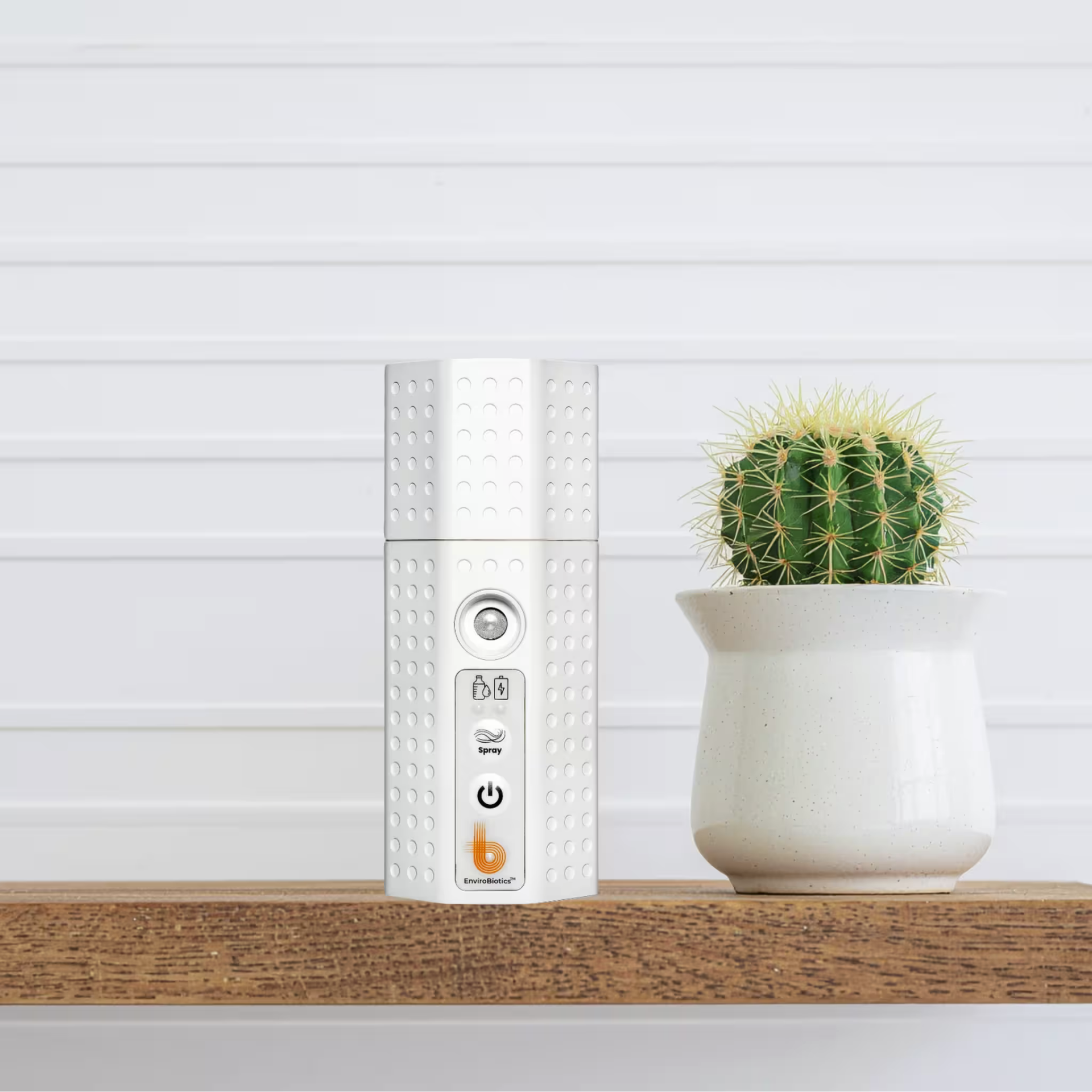
These are wall-mounted or freestanding units that release a fine probiotic mist on a schedule, usually a few seconds every 30–60 minutes. The mist is so light it's not visible, doesn't wet surfaces, and doesn't leave residue. Over the course of a day, the device covers every horizontal and most vertical surfaces in its coverage range.
Where they're useful: establishing and maintaining a probiotic surface layer across a whole room or whole house. Once running, the device does the work continuously, which is what's actually needed for the microbiome to shift and stay shifted.
Where they fall short: they cost more upfront than a spray bottle. And they have a coverage radius, a room-scale dispenser won't seed a 3,000 sq ft house.
The handheld form is the one people picture when they read "probiotic spray." The continuous form is what most people actually need, because the surface microbiome isn't a one-time thing you fix and walk away from.
"Looking for a probiotic dispenser for a single room? See the BioLogic Mini Gen 2, covers up to 300 sq ft.
Do probiotic sprays actually work?
Short version: yes, when used correctly. With a few important caveats.
The mechanism is well-established in microbiology. Competitive exclusion, beneficial bacteria getting to the food and space first, is the same process that lets a healthy gut microbiome keep C. difficile from overgrowing, or that lets probiotic starter cultures dominate fermented foods. The same principle works on indoor surfaces.
What the clinical data shows specifically for Bacillus-based indoor probiotics: a study at the University of Genova found that after probiotic deployment in a controlled indoor environment, surface viral loads dropped by 67% within 15 minutes and 97.7% within three hours. That's a comparison between probiotic-treated and untreated surfaces in the same room. Indoor Biotechnologies measured a significant reduction in dust mite allergens within eight days of continuous probiotic deployment in tested rooms.
The caveats: Spot treatment alone is weak. A single spray once doesn't shift the microbiome. The probiotic has to be reapplied frequently enough that the Bacillus population stays dominant. Pair it with disinfectants and you cancel both. If you bleach a counter and then spray probiotics on it, the residual chlorine kills the probiotics. Pick one approach and stick with it. It doesn't replace mold remediation. If there's actively growing mold larger than about ten square feet, you need a remediation contractor, not a probiotic spray.
How to pick a probiotic spray or dispenser
A short checklist:
1. Look for the specific Bacillus strains on the label. Generic "probiotic" with no species named is a red flag. 2. Check for certifications. FDA GRAS classification, MADE SAFE, and EPA Registered status are the markers that the product is what it says it is. 3. Confirm there are no disinfectant ingredients. No bleach, no quats, no alcohol, no fragrance. 4. Match coverage to your space. A handheld bottle is for spot work. A dispenser should be sized for your room, most room-scale units cover 300–800 sq ft. A whole-house need requires an HVAC-integrated system. 5. Look at refill cost, not just device cost. The economics of probiotic systems are in the refills. A cheap device with expensive proprietary refills can cost more long-term than a more expensive device with reasonable refills.
The EnviroBiotics product line was built around this checklist. The BioLogic Mini Gen 2 is a room dispenser for spaces up to 300 sq ft. The Biotica 800 handles up to 800 sq ft. Both use Bacillus strains that carry FDA GRAS classification, MADE SAFE certification, and EPA Registered status. No ozone, no VOCs, no fragrance, no chemicals.
For whole-house coverage, the E-Biotic Pro is HVAC-integrated and disperses through your existing ducts, same probiotic mechanism, applied at scale.
The bottom line
A probiotic room spray isn't a fragrance, an air freshener, or a disinfectant. It's a different category, a product that uses live beneficial bacteria to shift the surface microbiome in your favor. Handheld sprays are useful for spot treatment. Continuous dispensers are what most homes actually need, because surface microbiomes don't stay shifted unless something keeps reapplying the probiotics. Used correctly, the approach is well-supported by clinical data and decades of commercial deployment. Used as a one-time spray and walk away, it'll underdeliver.
If you've been Googling "probiotic spray" because you've read about the indoor microbiome and want to try it, the better starting point is the dispenser form, and the better thing to read next is what indoor microbiome health actually is.
Frequently Asked Questions
What is a probiotic room spray? A probiotic room spray is a product that releases live beneficial bacteria, typically Bacillus spores, into the air and onto surfaces. Instead of killing microbes the way a disinfectant does, it seeds rooms with harmless bacteria that outcompete odor-producing and allergen-causing microbes for space and food.
Are probiotic sprays safe? The Bacillus strains used in consumer probiotic sprays are FDA GRAS (Generally Recognized as Safe), the same classification used for food ingredients. They contain no chemicals, no fragrance, and no ozone. They're safe around infants, children, and pets when used as directed.
Do probiotic sprays actually work? Yes, when used consistently. The mechanism, competitive exclusion, is the same one that keeps a healthy gut microbiome stable. Clinical studies show measurable reductions in surface viruses (97.7% within three hours, University of Genova) and dust mite allergens (within eight days, Indoor Biotechnologies). A single spray won't do it; the probiotic needs to be reapplied frequently enough to keep the Bacillus population dominant on surfaces.
What's the difference between a probiotic spray and a probiotic dispenser? A spray is a handheld bottle for spot treatment. A dispenser is a stationary unit that releases probiotic mist on a continuous schedule across a whole room. Dispensers are more effective for ongoing microbiome maintenance; sprays are useful for targeted areas.
Can I use a probiotic spray with a disinfectant? No, not at the same time. Disinfectant residues (bleach, quats, alcohol) kill the probiotic bacteria you're trying to establish. Pick one approach per surface. If you want to deep-clean first and then maintain with probiotics, let surfaces dry and ventilate before applying the probiotic.
Will a probiotic spray get rid of mold? Probiotic sprays help prevent new mold growth by occupying the surface niches mold would otherwise colonize, and they help with the musty smell mold produces. They don't remove an existing mold infestation. Visible mold larger than about ten square feet needs a remediation professional.
How long does it take to see results? Most people notice a difference in surface odors within a week. Allergen-level changes typically show up in two to four weeks. The University of Genova study measured a 97.7% drop in surface viruses within three hours of probiotic deployment, that one's fast, but it requires the product to actually reach the surfaces being measured.
Want one device that covers a whole home through your HVAC? Explore the EnviroBiotics whole-home and room systems.
Ready to improve your indoor environment?
Discover our range of probiotic air purification solutions designed to create healthier spaces for you and your family.
Add EnviroBiotics as a preferred source
Get our latest research, guides, and air-quality insights highlighted in your Google experience.